
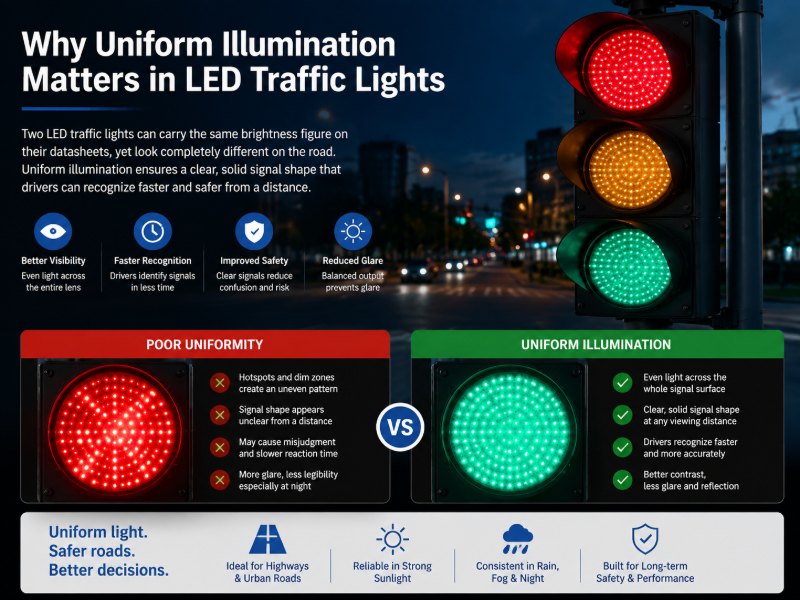
Two LED traffic lights can carry the same brightness figure on their datasheets, yet look completely different on the road. One presents a clean, evenly lit disc of color that reads instantly from 150 meters away. The other shows a cluster of glaring bright points floating on a dimmer background — technically “on,” visually confusing. The difference between them comes down to one optical property that many three-color traffic light buyers never think to ask about: illumination uniformity.
At Qixiang Traffic, we treat uniformity as a core optical design requirement, not a cosmetic detail. This article explains what uniform illumination actually is, why it directly affects intersection safety, and how to evaluate it before you place an order.
1. What “Uniform Illumination” Actually Means
Uniform illumination refers to how evenly light spreads across the entire emitting surface of a signal. When a red indication is energized, the full 300mm circle should glow as one coherent shape — the center, the edges, and every point in between should present a consistent level of light to the driver’s eye.
The opposite of uniformity is a signal dominated by hotspots and dim zones. Hotspots are small areas where individual LEDs punch through with concentrated intensity. Dim zones are the gaps between them, where the lens fails to blend the light into a continuous surface. From a distance, the human eye stops seeing a signal “shape” and starts seeing scattered points of light.
A useful mental test: imagine photographing the signal face in fog or light rain. A well-engineered optical system will still show a complete, solid colored circle. A poor one will dissolve into a spotty, streaky pattern.
2. The Eye Reads Shapes, Not Lumens
Driver recognition of a three-color traffic light is a shape-recognition task, not a brightness-detection task. Research into visual perception shows that the human eye identifies signal indications by the outline and fill of the colored area — a solid octagon or circle of red, amber, or green — long before it consciously processes intensity values.
This has a direct consequence for signal optics. If light is distributed evenly, the perceived shape stays crisp and stable at any viewing distance. If light concentrates in hotspots, the perceived shape becomes unstable: at medium distances the signal may look like multiple small lights instead of one indication, and drivers lose a fraction of a second deciding what they are looking at.
At highway approach speeds, a fraction of a second is several meters of travel. Uniformity is therefore not merely about appearance — it is part of the reaction-time budget that keeps a stop line safe.
3. Where Poor Uniformity Creates Real Danger
Uneven light output produces three specific field problems that procurement teams should understand:
Ambiguous arrow and symbol signals. Directional arrows, bicycle symbols, and pedestrian pictograms are the most demanding indications for an optical system. Their geometry is irregular by design. When illumination is uneven, the narrow parts of an arrow — the tip and the shaft — can fall below the brightness of the wide tail, making the arrow’s direction harder to decode at distance. In left-turn applications this ambiguity directly affects gap-acceptance decisions.
False “off” impressions. A signal face with visible dark patches between LEDs can be misread at a glance, particularly in low sun or under streetlight competition. Drivers approaching quickly may perceive a partially dark face as a degraded or changing indication, triggering either unnecessary hard braking or hesitant entry into the intersection.
Glare without legibility. Hotspots push peak intensity far above what the average level requires. At night, or on wet roads where the signal reflects in the pavement, these concentrated points generate glare that degrades the very contrast the signal depends on. The result is a signal that is simultaneously too bright in spots and too weak overall — the worst of both conditions.
4. Brighter Is Not the Fix
When a signal looks weak in the field, the instinctive response is to specify higher-power LEDs. This usually makes things worse.
Raw intensity does not repair an uneven light pattern; it amplifies it. The hotspots become more glaring while the dim zones stay relatively dim, so the contrast problem inside the signal face grows alongside the total output. Excess intensity also aggravates sun-phantom issues in bright climates, where external light entering the lens can create misleading reflections.
The professional approach is the reverse: first engineer the light distribution so the emitting surface is uniform, then set overall intensity to the level the viewing distance and ambient conditions require. A moderately powered signal with excellent uniformity will outperform a high-power signal with patchy distribution in nearly every real-world recognition test.
5. The Engineering Behind an Even Signal Face
Uniform illumination is manufactured, not luck. Several design decisions determine whether a signal face blends into one continuous color:
LED pitch and layout. The spacing, quantity, and arrangement of LED chips must be calculated against the lens geometry, so that the light cones of adjacent LEDs overlap and merge rather than leaving dark intervals. Symmetric layouts with optimized pitch are the foundation of an even face.
Lens and diffuser optics. Each LED sits behind a lens module engineered to spread its output laterally. In higher-grade signal heads, an additional diffusing layer further homogenizes the merged light. The quality of this optical chain matters more than LED brand — two signals using identical chips can look entirely different behind different lens systems.
LED binning. LEDs are graded by color and intensity tolerance at the factory. Mixing LEDs from wide or inconsistent bins produces visible brightness variation across the face. Consistent binning, matched with balancing resistors or current control on the driver board, keeps every chip contributing equally.
Thermal management. LED output drifts with temperature, and different regions of a signal head cool at different rates. A head with uneven heat dissipation can develop brightness variation after extended operation. This is why thermal design is quietly also an optical design issue.
6. How Uniformity Is Specified and Verified
Uniformity can be expressed numerically as a ratio between the brightest and dimmest measured points across the emitting surface, sampled on a defined measurement grid. A lower ratio means a more even face.
Buyers evaluating LED traffic light suppliers can ask three practical questions:
Does the LED traffic light supplier measure and record light distribution across the full signal face, or only total intensity at the center?
Are uniformity checks performed after the aging process, not just on fresh units, since output drifts in the first hours of operation?
Can the supplier provide sample test data for the exact indication types in your project — including arrows and symbols, which behave differently from full-screen discs?
A LED traffic light supplier who can answer these questions concretely is one who engineers uniformity deliberately rather than hoping the datasheet averages out.
7. Simple Field Checks Any Buyer Can Perform
Even without laboratory equipment, uniformity problems reveal themselves quickly:
The off-axis walk. View the LED traffic lights from 30, 45, and 60 degrees off the main approach axis. Uniform signals hold an even face across wide angles; marginal ones collapse into spots as the viewing angle widens.
The night observation. Unevenness that hides in daylight becomes obvious after dark. Look for hard bright points and shadow gaps within the colored disc.
The symbol test. Compare a full-screen disc and an arrow side by side. If the arrow looks less solid or less readable than the disc at equal distance, the optical system is struggling with geometry.
The long-range read. From the farthest point a driver would realistically first see the signal, check whether the indication reads as one shape or several points.
Uniformity Is a Safety Specification, Not a Preference
Illumination uniformity sits in the same category as IP rating, working temperature range, and vibration resistance: a measurable property that decides how a signal performs for real drivers in real conditions. Two products with identical wattage, identical housing sizes, and identical price tags can deliver completely different levels of intersection safety, purely because of what is happening behind the lens.
When comparing LED traffic light suppliers, add one question to your evaluation checklist: ask how the light is distributed across the signal face — and ask to see the evidence.
Qixiang Traffic Equipment Co., Ltd. designs and manufactures three-color traffic lights, vehicle and pedestrian LED traffic lights, solar traffic lights, and traffic signal controllers with optical uniformity engineered into every indication. To discuss the optical requirements of your project, or to request sample test data for your specifications, contact our team — we will help you configure a signal solution built for clear recognition at every viewing distance.
Post time: Aug-25-2026


