
In our everyday travel, we frequently encounter yellow traffic lights that are flashing non-stop at country intersections, in front of schools, and on curves and slopes. People usually call these flashing yellow lights. Many drivers are confused by this: why are there only flashing yellow lights at some sections of the road, while normal intersections have regular traffic lights? What makes them different from the normal traffic lights? What are the national regulations for the road conditions? In fact, flashing yellow lights are not just simple decorative lights, but important warning and safety facilities for road traffic. They are mainly used for the reduction of the speed of traffic, to caution the driver and to avoid accidents. They are suitable for the road sections with low traffic volume, poor visibility and no requirement for strict time-based traffic control. Today, Qixiang will introduce the basic definition of flashing yellow lights, and will introduce the various road conditions that need to install them.
A. What are flashing yellow lights?
Yellow flashing lights (or yellow flashing warning lights) operate by flashing yellow light at a high frequency (intermittently). They are not traffic lights as we know them controlling traffic with alternating red and green lights. They are mainly used to warn and remind drivers and to control speed and flow. The operating modes are divided into two types: mains power supply and solar self-power. Usually they just flash the lights all the time. Some smarter ones can be set on a timer to go on and off . This is mostly for warning at low traffic intersections.
B. Rural and suburban roads
Priority deployment of flashing yellow lights is mandated.
1. Intersections of rural and urban secondary roads with rural level crossings:
Rural intersections with large elevation differences between main and secondary roads and uneven traffic flow, without traffic light control, should be equipped with flashing yellow lights to remind vehicles on the main road to give way to agricultural vehicles and pedestrians crossing.
2. Unbarriered provincial and county road village entrances:
The entrances of the village are directly connected with main roads, which seriously affect the visibility; regulations require flashing yellow lights to reduce the probability of accidents involving pedestrians crossing.
C. Installation in schools, residential areas and other densely populated areas is mandatory
1. Roads in front of primary and secondary schools and kindergartens:
Concentrated pedestrian traffic during peak school hours, relatively light daily vehicle traffic and consequently low usage of conventional traffic lights. Some are timed, but all have flashing yellow lights, mainly to protect crossing students.
2. Street-facing entrances of older residential communities:
Residential gates directly face municipal roads, with frequent vehicle traffic and limited visibility. Installing flashing yellow lights reminds passing vehicles to slow down and give way.
D. Mandatory Installation at Limited Visibility and Special Traffic Junctions
1. Entrances to curves, slopes, and tunnels:
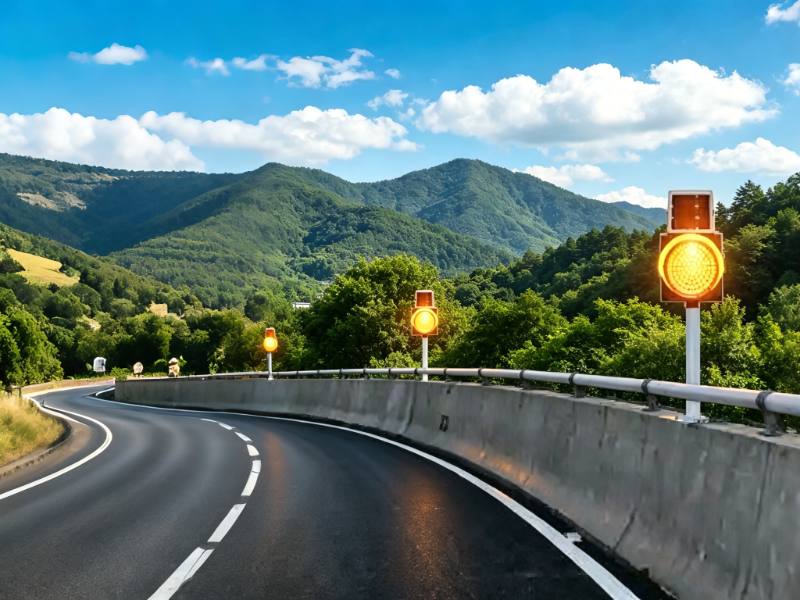
Long descending slopes, sharp curves with blind spots, tunnels with strong light changes all need flashing yellow lights to reduce the difference in the visual environment and remind the driver to slow down in time.
2. Railway crossings and factory/Industrial park entrances:
Unmanned railway crossings and factory gates have frequent large vehicle traffic and flashing yellow lights are required according to traffic management regulations to avoid accidents caused by large vehicles.
E. Low-Traffic Intersections at Night
1. Urban Intersections with Sparse Traffic at Night:
Traffic lights on main urban roads in the early morning switch to full flashing yellow mode, canceling the timing control, and reducing unnecessary waiting for vehicles.
2. Temporary Road Detours During Construction:
Mobile Flashing Yellow Lights Deploy mobile flashing yellow lights temporarily to warn vehicles to slow down when changing lanes for road construction and temporary lane changes.
Yellow flashing lights are not like normal traffic lights , because they are not trying to control right-of-way . Instead , they use yellow light ‘s high visibility to provide a warning . They are suitable for installation at intersections with poor visibility, mixed pedestrian and vehicle traffic, high accident rates, or sparse traffic flow, meeting national standards. They are also widely used by traffic management departments to reduce accidents and optimize the road conditions at low cost.
Customers needing yellow flashing lights or traffic signals are welcome to inquire. Qixiang can customize specifications to your needs, offering a full range of solar-powered and AC-powered models. We offer factory-direct wholesale, ensuring reliable qualivery.
Post time: Jun-03-2026


