
At the zebra crossing at the intersection of Guihua Road and Dasi Lane, Fuyang’s first touch-sensitive pedestrian crossing signal light was officially put into operation recently. Pedestrians simply need to press the application button on the pedestrian crossing signal light pole to cross the street. The pedestrian signal turns green, and the vehicle signal turns red, allowing pedestrians to cross safely.
The “touch-sensitive pedestrian crossing signal light” has a novel design, unlike ordinary traffic lights on roads, and is operated by the pedestrian. The green button on the signal light itself reads, “Please press the button to cross the street.”
The application button on the light pole was pressed by a traffic police officer to show how the system worked. The pedestrian signal light turned red at this point, while the vehicle signal light on the “touch-sensitive pedestrian crossing signal light” turned green.
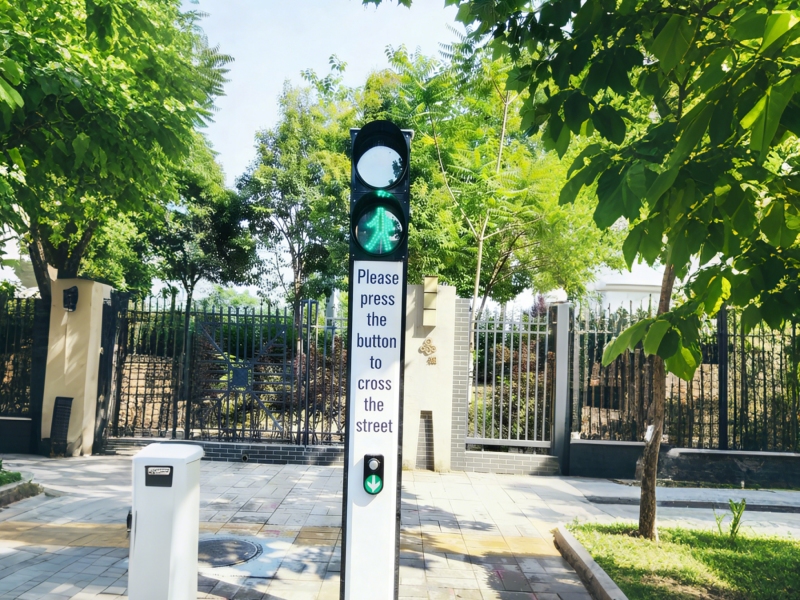
The pedestrian signal light then displayed a 10-second red countdown before entering the changing phase. After the 10-second red countdown, the vehicle signal light turned red, and the pedestrian signal light turned green.
The pedestrian traffic light has a 15-second countdown timer. After the countdown, the vehicle traffic light turns green again, and the pedestrian traffic light turns red. The timing of the light changes depends on the situation.
It is understood that when there is no pedestrian request to cross the street, the vehicle traffic light on the “touch-sensitive pedestrian crossing signal” is always green, and the pedestrian traffic light is always red, without affecting the efficiency of vehicle traffic.
“It should be noted that pedestrians cannot cross the street immediately after pressing the button!” traffic police stated. To avoid affecting vehicle traffic, after a pedestrian presses the request button, the request signal is transmitted to the signal control unit. The signal control unit responds within a set time. Only after the set minimum green light time for vehicles has ended will the vehicle traffic light change from green to red, and the pedestrian traffic light will turn green, at which point pedestrians can safely cross. Additionally, pedestrians should avoid pressing the button too often. Every request has a crossing cycle; the subsequent request won’t be addressed until the preceding crossing cycle has concluded. If the preset minimum green light time for motor vehicles is about to end, the pedestrian signal light will turn green in a few seconds; otherwise, the waiting time may be longer.
Furthermore, if subsequent pedestrians need to cross the street but the green light time is less than 5 seconds, they only need to press the request button again. The system will automatically add 10 seconds to ensure safe passage, and the pedestrian light will flash green to prompt pedestrians to cross quickly. However, to minimize the impact on motor vehicle traffic, the system only accepts one additional time request.
Traffic police stated that vehicles that do not comply with the instructions of the newly added “touch-sensitive pedestrian crossing signal light” will be punished in the same way as those who run red lights at intersections. The traffic police department will strengthen supervision and punish such traffic violations in the future. So, where are pedestrian crossing buttons suitable? First, let’s understand what a pedestrian crossing button is. When no pedestrian requests to cross, the vehicle traffic light is always green and the pedestrian light is always red. This situation is known as a pedestrian crossing button. When the pedestrian needs to cross, they press the button, sending a request signal to the signal control unit. The signal control unit guarantees pedestrian safety by changing the pedestrian light from red to green and the traffic light from green to red within a set period of time.
When installing pedestrian crossing buttons, traffic police departments give priority to both pedestrian safety and effective vehicle traffic flow. The installation of this signal light shouldn’t significantly affect traffic on the roads.
1. Placed on sections of the road where cars are not significantly affected.
2. To ensure students’ safety when crossing the street at school entrances.
3. On long, one-way roads with few pedestrians.
Post time: Feb-26-2026


