
Street traffic signals are core facilities for safe passage at urban intersections, and their installation quality directly affects traffic order and driving safety. Only by strictly adhering to national standards and specifications, and ensuring a thorough process from preliminary surveying and standardized installation to commissioning and acceptance, can the long-term stability, clear visibility, and ease of maintenance of road signal lights be guaranteed. Urban traffic signal producer Qixiang details the standard installation process and key precautions for road signal lights.
I. Preliminary Site Survey and Location Planning
A complete on-site survey of the intersection must be made before installation. The placement of the traffic light poles, the height of the lights and their orientation must be determined based on the number of lanes, traffic flow, pedestrian traffic patterns and visibility obstructions. The installation locations should be selected strictly according to national standards and should not be in the areas obstructed by trees, buildings or large vehicles. The wiring path and the location of the pre-buried pipeline should be planned in advance, and the dimensions of the foundation should be calculated accurately, to ensure safe installation and standard wiring and to avoid rework and modification later.
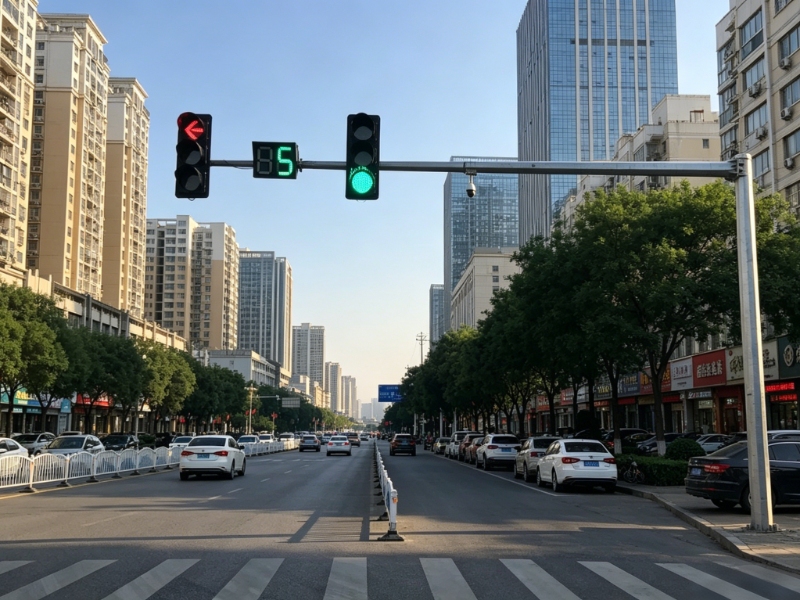
II. Foundation Pouring and Pole Erection Construction
Excavate the foundation pit and pre-embed anchor bolts according to the construction drawings. Then pour regular concrete for the foundation. You should only set up the poles when the foundation has completely solidified and meets the standards . When installing the light poles, make sure they are straight down and up and are well supported. Tighten the bolts well to avoid the light poles leaning or swaying from the vibrations of vehicles or strong winds. During wiring, ensure proper conduit protection, with wires protected by conduits, and implement waterproofing, moisture-proofing, and anti-aging treatments to eliminate safety hazards such as leakage and short circuits.
III. Street Traffic Signal Equipment Installation and Wiring Testing
Secure the traffic light fixtures, countdown timers, pedestrian lights, etc. ensuring the lights are aimed directly at oncoming traffic and the light-transmitting surfaces are unobstructed and not misaligned. When wiring, be sure to clearly differentiate between power lines and signal lines, make sure the connections are secure and neat, and provide appropriate insulation and waterproofing. After installation, switch on the power and test the equipment, check the switching of the red-green-yellow light, the countdown display, and the synchronized timing, to ensure uniform light brightness, no glare at night, and high visibility during the day.
IV. Acceptance Inspection and Post-Construction Maintenance Key Points
After the completion of the overall construction, each item shall be inspected according to national standards for installation firmness, waterproof performance, signal synchronization and operational stability. Check regularly the integrity of the casing and the state of the wiring during daily use, clean the dust off the lamp covers promptly and ensure that the street traffic signals work normally round the clock. Proper installation and routine maintenance are the keys to longer traffic light life and safer passage through intersections.
Urban traffic signal producer Qixiang is a high-quality traffic light manufacturer with complete specifications and guaranteed quality. We manufacture for municipal engineering. Our road signal lights can be sold in bulk. We also support customized solutions. Prices are reasonable and delivery is quick. Welcome to inquire and cooperate with us.
Post time: May-07-2026


