
In city road engineering , the main roads and local roads are very different in traffic volume, speed and visibility. Therefore, national standards clearly differentiate the sizes, specifications and structural parameters of outdoor signal poles. Proper signal lamp pole size selection provides traffic signal visibility, reduces engineering costs and is adaptable to changing road traffic requirements.
I. Standards for Size of Main Road Traffic Signal Poles
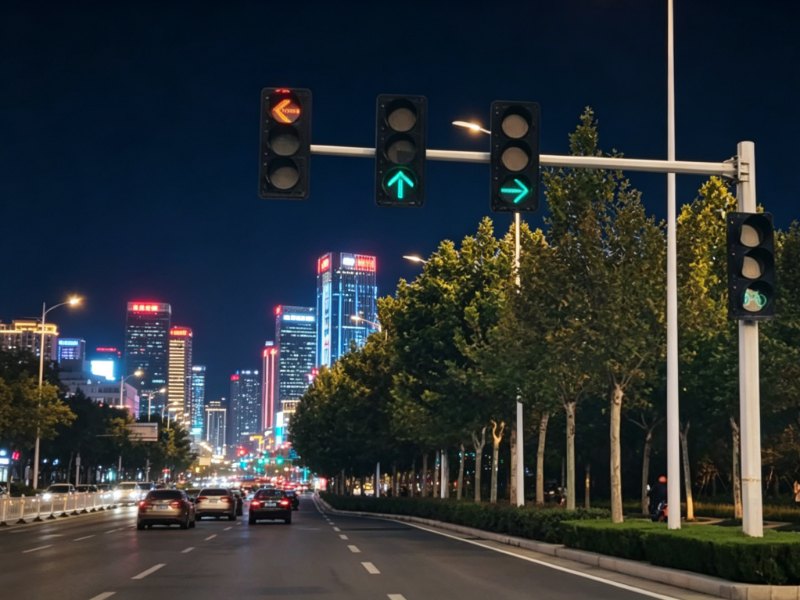
Urban main roads have high vehicle speeds, multiple lanes and heavy traffic volume, which calls for higher standards for signal lamp pole height, arm length and sturdiness. In general, big poles are more stable.
1. Parameters of Standard Height and Arm Length
Main road traffic signal poles are usually 6 to 8 m high (most common are 6.5 m and 7 m). The length of the cantilever arm is adapted to the number of lanes. For multi-lane roads of two ways, cantilever arms of 6~12 meters are generally adopted to guarantee the signal light is directly above the lanes, so that there are no blind spots, and the observation needs of long-distance and high-speed vehicles are satisfied.
2. Pole Structure and Wall Thickness Specifications
Main roads adopt mainly octagonal cantilever signal lamp poles. High wind resistance is required. The wall thickness of the standard pole is 3.0mm to 3.5mm and the flange base and embedded parts are higher specification. The overall structure is strong and sturdy and can support multiple traffic lights, surveillance and image capturing devices, suitable for long term high volume traffic.
II. Standards for the Size of outdoor signal poles on Branch Roads
The speeds of vehicles on residential branch roads, rural branch roads and urban auxiliary roads are slow, the number of lanes is small, and there are few pedestrians and vehicles. The light poles should be lightweight and compact, with smaller dimensions and higher cost-effectiveness.
1. Parameters of Standard Height and Arm Length
The height of the branch road traffic light poles is generally 4 meters to 5.5 meters, and the commonly used fixed height is 4.5 meters and 5 meters. The length of the cantilever arm is shorter, generally 2 meters to 4 meters, only covering 1-2 lanes, which can fully meet the signal observation needs of low-speed traffic and avoid waste of resources.
2. Signal Lamp Pole Structure and Wall Thickness Specifications
Branch road light poles are mainly round poles or small octagonal poles, the wall thickness is 2.0mm ~ 2.5mm, the chassis and embedded parts are smaller. Light weight, easy to install, low requirements for the load, only bear basic traffic signal devices, and can be used in narrow road traffic situations.
Therefore, main road light poles are featured by height, length, thickness and stability, which is suitable for multi-lane, high-speed and heavy traffic flow; branch road light poles are featured by height, shortness, lightness and simplicity, which is suitable for narrow lanes, low-speed and light traffic flow. The corresponding dimensions should be matched according to the road grade during construction and procurement to guarantee traffic safety and control project cost effectively.
Qixiang is a professional manufacturer of all kinds of traffic signal poles, with a full range of styles and specifications, covering different heights and arm lengths, including octagonal poles, conical poles, cantilever poles, etc. It can be used in a variety of sites such as urban principal roads, rural minor roads, and park roads. It supports non-standard size customization, thick materials and excellent workmanship, corrosion resistant, rust-proof, sturdy and durable, and has sufficient stock for fast delivery to meet the procurement needs of various municipal transportation projects.
Post time: May-20-2026


