
Road traffic lights may look similar from a distance, but the operating environment behind every installation can be very different. A signal used at a busy urban intersection does not necessarily have the same requirements as one installed on a rural road, near a school, or at a temporary construction site.
For contractors, traffic authorities, and project buyers, selecting a LED traffic signal therefore involves more than deciding between red, yellow, and green. Visibility, power supply, installation method, traffic volume, weather exposure, maintenance conditions, and control requirements should all be considered before a suitable solution is selected.
As a professional LED traffic signal manufacturer, Qixiang believes that matching the signal equipment to the actual road environment is one of the most important steps in building a reliable traffic control system.
1. Busy Urban Intersections: Focus on Visibility and Coordination
Urban intersections usually present the most demanding operating conditions. High vehicle volumes, pedestrians, buses, bicycles, turning traffic, and multiple lanes may all need to be controlled within the same intersection.
For these locations, signal visibility is particularly important.
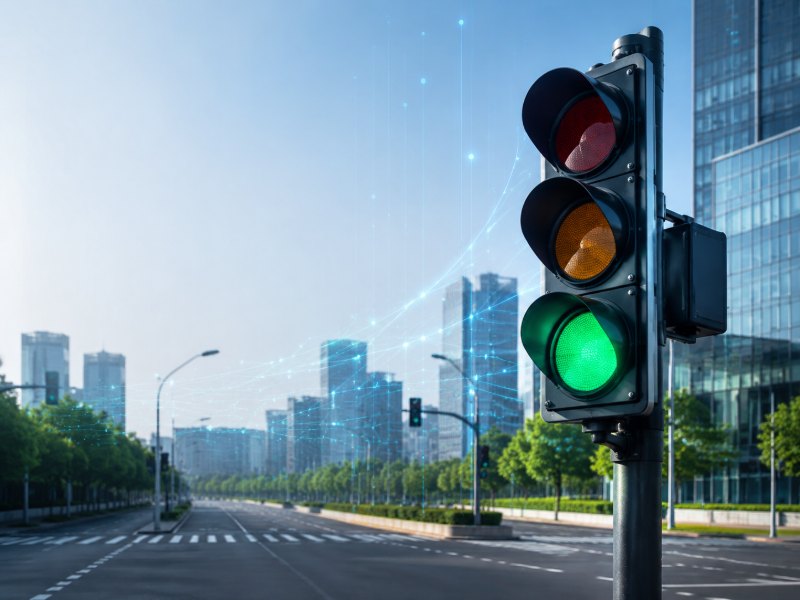
Road traffic lights with clear optical output can help drivers identify signal indications under different ambient light conditions. Depending on the intersection layout, full-screen signals can be combined with arrow signals to provide separate instructions for straight, left-turn, or right-turn movements.
However, the signal head itself is only one part of the system.
At complex intersections, the traffic signal controller must coordinate different phases effectively. Vehicle signals, pedestrian signals, countdown timers, and other traffic control equipment may need to operate together.
For this reason, urban projects should be evaluated as complete traffic control systems rather than as purchases of individual lamps.
2. Wide Multi-Lane Roads: Consider Long-Distance Recognition
The wider the road becomes, the more attention should be paid to signal recognition distance.
Drivers approaching a large intersection may need to identify the signal well before reaching the stop line. Large vehicles can also temporarily obstruct the driver’s view of a signal installed at an unsuitable position.
In these applications, project designers should consider factors such as:
Signal head size
Installation height
Pole and cantilever configuration
Viewing angle
Lane arrangement
Background interference
Approach speed
A larger signal is not automatically the best solution. Correct positioning is equally important. The objective is to create a signal layout that drivers can recognize naturally while approaching the intersection.
3. Rural Roads: Reliability Can Be More Important Than Complexity
Rural traffic environments are often very different from city centers.
Traffic volumes may be lower, but maintenance teams can be located far away. Some locations may also have limited access to stable electrical infrastructure.
Under these circumstances, a simple and reliable configuration may be more practical than an unnecessarily complicated system.
When selecting road traffic lights for rural projects, buyers should pay particular attention to outdoor durability, energy consumption, maintenance requirements, and the availability of replacement components.
Where connection to the electrical grid is difficult, a solar traffic light can also be considered depending on local sunlight conditions and project requirements.
Solar-powered configurations can reduce dependence on conventional power infrastructure and can be useful for certain remote or difficult-to-wire locations.
4. Road Construction Areas: Mobility Changes the Requirements
Temporary roadworks create another completely different application.
A conventional fixed traffic signal installation may not be economical when the traffic control arrangement is required only during construction.
This is where mobile traffic lights become useful.
They can be deployed for temporary lane control, road maintenance, bridge work, construction zones, or locations where traffic patterns change for a limited period.
When selecting a mobile system, buyers should examine more than portability. Battery endurance, signal visibility, structural stability, control method, deployment speed, and outdoor protection should also be considered.
A good temporary traffic signal should be easy to move without becoming unreliable after repeated transportation and installation.
5. School Zones and Pedestrian Areas: Drivers Are Not the Only Users
Traffic signal selection should not focus exclusively on vehicles.
Around schools, hospitals, residential communities, commercial districts, and other pedestrian-intensive areas, pedestrian movements can become a major part of intersection design.
Pedestrian signals should provide clear information that can be understood quickly. Depending on the project, countdown displays may also be incorporated to give road users additional information about the remaining crossing period.
The placement of pedestrian signal heads is especially important because their viewing position differs significantly from that of vehicle signals.
Instead of simply adding pedestrian lights to a vehicle signal system, engineers should consider pedestrian movement as an independent part of the overall intersection design.
6. Industrial Parks: Match the Signal to Vehicle Characteristics
Industrial roads can include trucks, forklifts, employee vehicles, loading areas, and internal intersections.
Compared with ordinary urban streets, the proportion of large vehicles may be much higher.
This changes signal requirements.
Signal positions should remain visible even when trucks are present, while poles and supporting structures should be arranged according to the actual road width and vehicle movement.
In some industrial environments, LED traffic signals may also need to coordinate with gates, access control equipment, warning devices, or internal traffic management systems.
Therefore, buyers should inform the traffic signal manufacturer about the actual operating environment instead of purchasing only according to a standard product specification.
7. Harsh Weather Areas: Examine the Entire Housing System
Traffic lights operate outdoors continuously, so environmental protection should never be treated as a secondary consideration.
Rain, dust, strong sunlight, temperature changes, wind, and long-term exposure can affect signal performance.
When evaluating an outdoor LED traffic light, buyers should consider the complete construction of the product, including:
Housing:
The housing should provide adequate mechanical strength and environmental protection for the internal components.
Lens and optical components:
These parts should maintain good visibility after long-term outdoor exposure.
Sealing:
Connections and openings should be properly protected against environmental intrusion.
Internal electronics:
Power supplies, LED modules, wiring, and control components should be designed for stable operation under the intended working conditions.
Mounting components:
Brackets and connections must remain secure throughout long-term outdoor installation.
A traffic signal is only as reliable as its complete structure. Evaluating LED brightness alone does not provide enough information about long-term performance.
8. Areas With Strong Sunlight: Pay Attention to Daytime Visibility
Strong sunlight can make signal recognition more challenging.
This is particularly relevant when sunlight reaches the signal face directly or when the surrounding environment contains bright visual backgrounds.
A well-designed LED traffic signal should maintain sufficient contrast so that drivers can distinguish the active indication without unnecessary hesitation.
Optical design, LED arrangement, lens construction, visor design, and installation direction can all influence daytime visibility.
For projects in regions with intense sunlight, buyers should discuss the actual environmental conditions with the supplier before finalizing the configuration.
9. Smart Intersections: Leave Room for Future Upgrades
Modern traffic management is gradually moving from isolated signal operation toward connected systems.
For a new intersection project, buyers should therefore consider not only current requirements but also possible future expansion.
For example, a traffic control system may later need to integrate vehicle detection, pedestrian requests, centralized management, communication equipment, or other intelligent transportation functions.
Selecting compatible LED traffic signal controllers and suitable system architecture at the beginning can make future upgrades easier.
This does not mean that every intersection needs the most advanced configuration available. The better approach is to choose a system with an appropriate level of expandability for the expected development of the road network.
What Information Should You Give a LED traffic signal Manufacturer?
One common purchasing mistake is asking a supplier only for a quotation without providing enough project information.
The more accurately the operating conditions are described, the easier it is for the manufacturer to recommend a suitable configuration.
Before requesting a quotation, it is useful to prepare information such as:
Road type
Number of lanes
Intersection layout
Required signal type
Available power supply
Installation method
Required signal dimensions
Local environmental conditions
Road traffic signals controllers requirements
Pedestrian control requirements
Quantity
Project standards or technical specifications
For customized projects, drawings or intersection layouts can also help the manufacturer understand the application.
Choosing Road Traffic Signals Is About Matching, Not Simply Buying
There is no single traffic light configuration that is ideal for every road.
A bu city intersection may require coordinated vehicle and pedestrian signals. A remote road may prioritize low maintenance and independent power. A construction zone may require mobility, while an industrial park may need a solution designed around heavy vehicles and internal traffic management.
The correct approach is therefore to start with the road environment and then determine the signal configuration.
Qixiang provides different types of road traffic signals, solar traffic lights, mobile traffic lights, traffic signal controllers, traffic poles, and traffic control solutions for various road applications. By understanding the road layout, operating environment, and control requirements of each project, an appropriate traffic signal solution can be configured for practical installation and long-term operation.
If you are planning a new traffic signal project, contact Qixiang with your road layout, technical requirements, or project specifications. Our team can help you evaluate the appropriate LED traffic signal configuration for your application.
Post time: Aug-13-2026


