
The Inefficiency of Traditional Fixed-Time Traffic Lights
Most traditional traffic lights have a fixed-duration green light logic, independent of the number of vehicles in each lane. In the morning rush hour, the main roads are congested and the green light time is not enough for the vehicles to pass through, leading to a backlog of vehicles; in off-peak hours, the side roads are empty, but the green light is fixed on them, leading to a serious waste of road resources. In case of emergencies, such as accidents or sudden surges in traffic, the traffic lights cannot adjust autonomously, easily leading to prolonged congestion.
How Smart Traffic Lights Achieve Adaptive Regulation
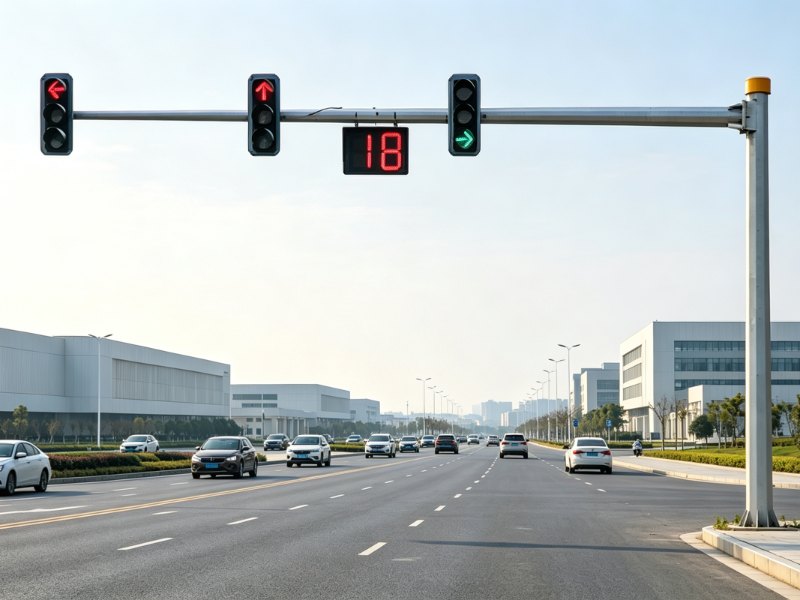
In order to gather real-time data on traffic flow, speed, queue length, and pedestrian counts in each lane, smart traffic lights employ sensors like radar, video recognition, and geomagnetic coils. After that, they dynamically alter the green light’s duration using backend algorithms. In order to accomplish the adaptive regulation of “longer green light for heavy traffic, faster green light for light traffic,” side streets with light traffic automatically shorten their green light duration, while lanes with heavy traffic automatically extend it. In order to shorten wait times for public transportation and improve overall traffic efficiency, some state-of-the-art products have vehicle-to-infrastructure (V2I) systems that can receive signals from private vehicles, ride-hailing cars, and buses.
Proven Performance in Urban Areas
In actuality, switching to smart traffic lights at intersections in typical urban areas resulted in a 15% to 30% increase in traffic efficiency and a significant decrease in the average waiting time for cars. In locations like schools and business districts where there are significant variations in both pedestrian and vehicular traffic, the optimization effect is particularly apparent. Some urban arterial roads have networked intelligent traffic signals that achieve green wave traffic, allowing vehicles to travel at a constant speed through green lights, significantly reducing congestion and exhaust emissions caused by starting, stopping, and braking.
Limitations and Challenges
However, smart traffic lights are not a panacea for congestion. If the intersection has narrow road planning and insufficient lanes, simply adjusting the signal duration cannot solve the congestion problem at its root. In older urban areas with dense road networks and small intersection spacing, signal coordination is difficult, and the optimization effect will be greatly reduced. Meanwhile, inadequate equipment maintenance, obstructed recognition cameras, and lagging algorithm updates all weaken intelligent control capabilities.
Qixiang’s Perspective on Traffic Optimization
Qixiang believes that intelligent traffic lights are a low-cost, high-efficiency means of alleviating traffic congestion, fully tapping the traffic potential of existing roads and alleviating routine short-term congestion. To completely solve urban traffic congestion, it is also necessary to coordinate with supporting measures such as widening roads, optimizing road networks, and developing public transportation. Only by building an integrated intelligent transportation system with intelligent traffic lights as the core of dispatching can the urban travel environment be improved in the long term.
Professional Intelligent Traffic Solutions by Qixiang
Pedestrian countdown lights, intelligent networked traffic controllers, solar-powered traffic lights, and conventional LED traffic lights are all expertly supplied by Qixiang. Our intelligent traffic signals can be customized in terms of size and functionality, have high light transmittance, are long-lasting, and are waterproof to IP65 standards. Traffic light poles are among the comprehensive solutions we offer, along with a thorough guarantee. If you would like to discuss intelligent traffic signals or have any questions, please get in touch with us.
Post time: Jul-21-2026


