
Traffic signal poles often leave the factory as separate shafts, arms, brackets, and hardware packages. At the installation site, these parts must form the assembly shown on the approved drawings. Trial assembly brings the intended components together before shipment, allowing connection problems to be found while factory equipment and technicians are available. For contractors with a scheduled lifting window, discovering a mismatch before dispatch can prevent avoidable interruptions.
Reveal Problems Between Mating Parts
Individual measurements do not always show whether two parts will fit together correctly. Bringing the actual pole and arm together helps inspectors check hole alignment, flange contact, and component orientation against the approved drawings. Small dimensional deviations can combine into a mismatch that becomes apparent only when mating components meet. A reversed connection plate or incorrectly positioned attachment becomes easier to identify. This evidence helps distinguish a fabrication error from an incorrect pairing. Where the design includes a slip joint, the inspection procedure should follow the specified engagement depth and assembly instructions.
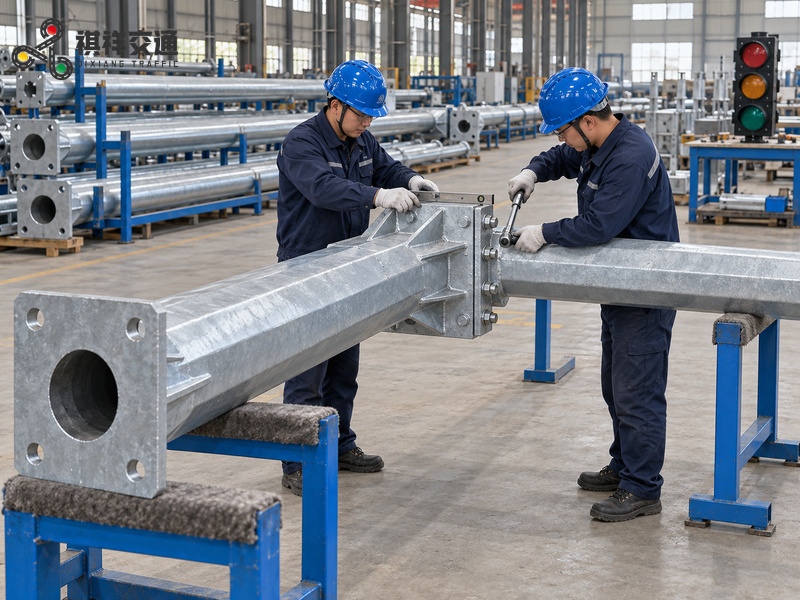
Check Hardware and Tool Access
A connection needs room for both its fasteners and the tools used to install them. Trial fitting with the specified bolts, nuts, and washers can reveal unsuitable bolt lengths, obstructed seating surfaces, or restricted wrench access. For example, a reinforcing gusset may leave a bolt hole clear while blocking the socket needed to tighten its nut. Such findings are easier to resolve before packing. Misaligned holes should trigger investigation and an approved correction; forcing parts together or enlarging holes without authorization can compromise the intended connection.
Account for the Finished Surface
Galvanizing adds zinc to the steel surface, which can affect close clearances and threaded fit. An assembly that fits before coating therefore needs a defined approach to verifying fit in its final supplied condition. The inspection plan should address coating buildup around relevant interfaces and any necessary cleaning. Corrections must follow the approved method and preserve the required corrosion protection.
Confirm Equipment and Cable Interfaces
Fitting the agreed brackets or representative mounting hardware can expose interference between accessories. Inspectors can also check that cable entry openings align with the internal cable route and remain accessible. This matters when signals, signs, or other equipment share one support. The exercise verifies practical compatibility within the agreed scope. Structural design verification, specified weld inspections, and electrical tests remain separate requirements.
Make Site Reassembly Repeatable
The value of trial assembly continues after components are separated for transport. Matching identification marks, orientation references, and photographs help installers reunite the correct parts in the checked arrangement. Keeping those identities attached throughout packing helps preserve the value of the factory check. Hardware packages should identify the connections they serve. Inspection records should document any correction and subsequent recheck. These details reduce uncertainty when similar arms or brackets arrive together and give the receiving team a useful reference during unpacking.
A useful trial assembly report records more than a pass mark. It connects the drawing revision, component identities, checked interfaces, and unresolved actions. Shipment release should follow the agreed acceptance process after relevant fit issues are closed. This creates a clearer handover from fabrication to installation. When requesting traffic signal poles from Qixiang, share the installation layout and discuss the required trial assembly scope, acceptance criteria, and delivery documentation before production begins.
Post time: Oct-10-2026


