
When ordering signal lighting poles, buyers usually pay attention to pole height, cantilever length, steel thickness, and surface treatment. However, one detail that is easily overlooked is the internal cable routing arrangement. Although cables are generally installed during the electrical installation stage, the space and openings required for them must be considered much earlier.
For traffic signal pole manufacturers, cable routing is not simply an installation issue. It directly affects hole positioning, access door design, fabrication procedures, and the compatibility of the finished structure with traffic signal equipment.
1. Cable Entry Positions Must Match the Actual Installation
Signal lighting poles commonly accommodate cables entering from underground conduits through the foundation area. These cables then pass through the pole body toward signal heads or other mounted equipment.
If the cable entry position is not confirmed before manufacturing, the finished pole may not align properly with the project’s underground conduit arrangement.
For example, a foundation may already have conduits positioned on one side, while the pole has been manufactured with an incompatible cable opening.
Confirming the foundation connection and cable entry arrangement in advance helps prevent additional modifications during installation.
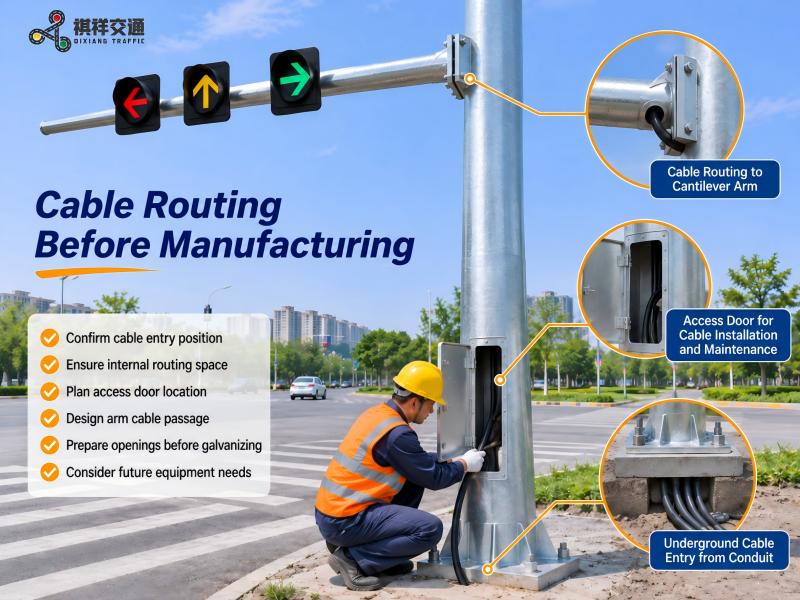
2. Internal Cable Space Should Be Considered
Different signal pole configurations require different quantities of cables.
A simple roadside traffic signal pole may carry fewer cables than a long cantilever pole supporting multiple signal heads, pedestrian signals, cameras, or detection equipment.
The manufacturer should understand the approximate cable quantity, outside diameters, and intended routing paths before finalizing the design.
Special attention should be given to internal restrictions around structural connections, reinforcing plates, and transitions between pole sections.
Sufficient space should be available for cable installation without forcing cables through unsuitable openings or exposing them to sharp metal edges.
3. Access Door Locations Affect Maintenance Convenience
Access doors provide technicians with a practical opening for cable pulling, inspection, and connection work where required by the electrical design.
An incorrectly positioned access door may make it difficult to reach internal wiring or access the designated connection area.
Its location should be coordinated with the pole structure, foundation arrangement, and expected maintenance direction.
For example, a door facing an inconvenient or unsafe working area may create unnecessary difficulties for future maintenance teams.
The opening and its reinforcement must also be incorporated into the structural design rather than added without engineering review after fabrication.
4. Cantilever Arms Require Their Own Routing Plan
For cantilever signal lighting poles, cables often need to travel from the vertical pole into the horizontal arm.
This transition requires careful planning because connecting flanges, internal reinforcement, and arm joints may restrict the available routing space.
The manufacturer should confirm where cables enter the horizontal arm and where they exit near each signal head.
Where detachable cantilever arms are used, the connection arrangement should permit cable installation without interference from fastening components.
Cable exit positions should correspond to the approved signal mounting locations, reducing the need for additional drilling on site.
5. Cable Openings Should Be Prepared Before Surface Treatment
Manufacturing sequence is another important reason to finalize cable routing early.
Signal lighting poles may undergo cutting, drilling, welding, surface preparation, hot-dip galvanizing, and optional powder coating.
Cable openings should normally be incorporated into the approved fabrication drawings and processed at the appropriate manufacturing stage.
If additional holes are drilled after galvanizing or painting, the exposed steel and damaged coating will require suitable protection.
Unplanned field modifications may also affect structural integrity if holes are made near welded joints, reinforced areas, or other critical locations.
Therefore, late changes should be reviewed by the manufacturer or responsible engineer instead of being carried out without approval.
6. Future Equipment Requirements May Influence Routing
Modern intersections may incorporate more than conventional traffic signal lights.
Cameras, vehicle detectors, communication devices, and other intelligent transportation equipment may require additional cables.
If these devices are included in the current project or planned for future installation, their routing requirements should be discussed before pole production.
Where appropriate, the design may reserve suitable pathways or approved openings for future equipment.
This approach can reduce unnecessary structural modifications when intersection systems are upgraded.
7. Confirm Cable Routing on the Final Production Drawings
Before production begins, buyers and manufacturers should review the cable routing details together.
Important information includes cable entry locations, access door positions, internal passage requirements, cantilever cable exits, and equipment mounting points.
The approved drawings should clearly identify relevant openings and their positions so that the production team can manufacture the correct configuration.
For projects involving several signal pole types, each configuration should be checked separately to avoid using the wrong opening arrangement.
Conclusion
Cable routing may appear to be a minor detail compared with the overall size and strength of signal lighting poles. However, poor planning can lead to installation difficulties, unnecessary drilling, coating repairs, and project delays.
By confirming cable requirements before manufacturing, buyers can achieve better coordination between the steel structure and electrical installation.
As a professional signal lighting pole manufacturer, Qixiang supports customized pole configurations based on project drawings and installation requirements. Customers are welcome to provide their cable routing information and signal equipment layout before production so that the final pole design can better meet actual project needs.
Post time: Nov-06-2026


