
Smart traffic signals effectively alleviate traffic congestion and ensure smooth traffic flow. However, smart traffic signals are not as simple as they seem, as they require adherence to certain requirements in both design and installation. So, are there height requirements for traffic light installation? Yes, there are.
Traffic light manufacturers specify the following installation height requirements for smart traffic signals:
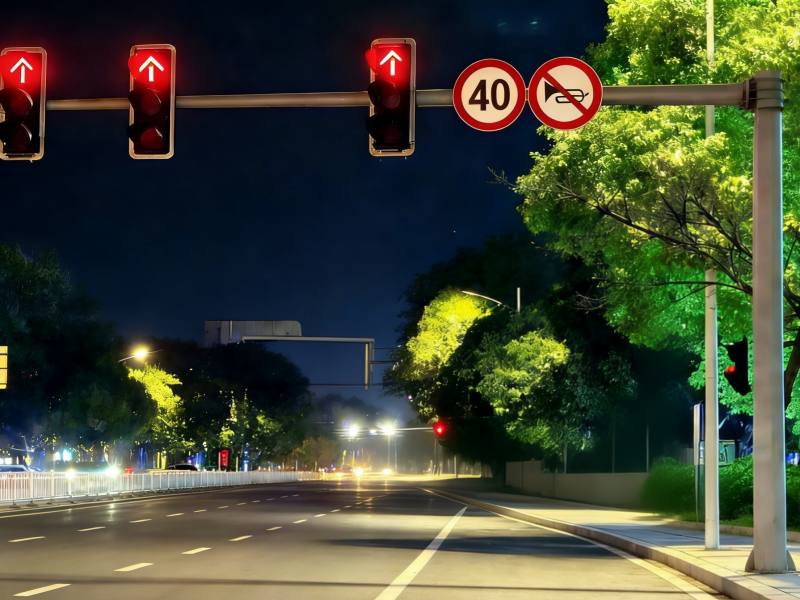
I. Intersection Smart Traffic Signals:
The height should not be less than 3m.
II. Pedestrian Crossing Smart Traffic Signals:
Installation height is 2m to 2.5m.
III. Lane Smart Traffic Signals:
1. Installation height is 5.5m to 7m;
2. When installed on an overpass, it must not be lower than the bridge’s clearance.
IV. Non-Motorized Vehicle Lane Smart Traffic Signals:
1. Installation height is 2.5m to 3m. When using a cantilevered installation method on a pole previously used for motorized vehicle smart traffic signals, it should meet requirement 7.4.2;
2. The cantilever length of the non-motorized vehicle traffic light should ensure that the light is positioned above the non-motorized vehicle lane.
V. Motor Vehicle Traffic Signals, Directional Indicator Signals, Flashing Warning Signals, and Intersection Signals:
1. When using cantilever installation, the height should be 5.5m to 7m;
2. When using post installation, the height should not be less than 3m;
3. When installed on an overpass, it should not be lower than the bridge’s clearance;
4. The cantilever length should not exceed the center of the inner lane if it is longer, and should not be less than the center of the outer lane if it is shorter.
The above are some height requirements for traffic signal installation. Of course, specific requirements should be determined by referring to relevant standards and local conditions.
Tips: Rationalization of the Number of Traffic Signal Devices at Intersections
1. One or more traffic signal groups can be installed at a specific intersection entrance as needed.
2. When a properly channelized triangular guide island is set up at the intersection, the traffic signal poles should generally be placed on the guide island.
3. When the distance between the approach parking line and the opposite traffic signal is large, the opposite traffic signal should be a signal light with a transparent surface diameter of 400mm.
4. When right-turn arrow smart traffic signals are installed on a right-turn island for motor vehicles, the right-turn arrow traffic light assembly can be directly installed on the right-turn island.
5. Smart traffic signals at the span of an overpass should be installed on the bridge structure or on the right side of the approach lane; if there are secondary parking lines under the overpass, an additional traffic light assembly should be installed on the other side of the overpass.
6. On roads without a median strip separating motor vehicle lanes and non-motor vehicle lanes, the traffic light poles for opposite directions should preferably be installed near the curb tangent point. When the road is wide, cantilevered installations can be used on the right-hand sidewalk.
7. Roundabouts are equipped with smart traffic signals to control vehicles entering and exiting the roundabout. Traffic light assemblies are installed inside the roundabout to indicate vehicles entering the roundabout, and traffic light assemblies are installed on the outer layer of the roundabout to indicate vehicles exiting the roundabout.
8. When a left-turn waiting area is marked at an underpass intersection or a large at-grade intersection, if vehicles entering the left-turn waiting area cannot easily observe the changes in the oncoming traffic light in their direction, it is advisable to add a left-turn arrow signal light group on the opposite side of the left-turn waiting area.
9. On roads with a median strip separating motor vehicle lanes and non-motor vehicle lanes, where the width of the median strip allows, the oncoming traffic signal light pole should be installed within 2 meters behind the tangent point of the median strip edge. When the road is wide, cantilevered installations can be used on the right-hand median strip, or a signal light group can be added within the left-hand non-motor vehicle median strip as needed. When the road is narrow, pole-mounted installations can be used within the median strips on both sides of the road.
Qixiang Traffic is a technology company integrating the development, production, installation, and technical services of urban road and intelligent transportation products. Our company adheres to product diversification and self-sufficiency in core products, continuously developing new products. With strict quality management, solid technical strength, and a high-quality service platform, we have won the trust and favor of many customers in the fierce market competition by offering reasonable prices, fast processing, and excellent service. If you have any needs, please feel free to contact us.
Post time: Jan-28-2026


