
A traffic signal pole may look like a simple steel structure, but its actual service life depends on much more than the material used to manufacture it.
Two traffic signal poles made from similar steel can have very different operating lives when they are installed in different environments, carry different loads, or receive different levels of maintenance. For road authorities, contractors, and traffic equipment buyers, understanding these factors is important when evaluating the long-term value of a signal pole.
So, what really determines the service life of a traffic signal pole?
1. Structural Design Comes First
The service life of a traffic signal pole begins with its structural design.
A pole must be designed according to its intended height, arm length, signal equipment, signs, cameras, and other accessories. A structure that is appropriate for a short roadside installation may not be suitable for a long-span overhead application.
The main structural factors include:
Pole height
Arm length and configuration
Steel section and wall thickness
Connection design
Equipment loading
Wind exposure
Foundation conditions
The longer the horizontal arm becomes, the more attention must be paid to bending forces and overall stability. Additional equipment mounted on the structure can also increase the load.
For this reason, service life should not be judged simply by looking at the diameter or appearance of a pole. The complete structural system needs to be considered.
2. Steel Quality Affects Long-Term Performance
The material forms the basic structural foundation of a traffic signal pole.
Steel used for outdoor traffic infrastructure needs sufficient strength, consistency, and weldability for the intended application. Material selection becomes particularly important when the pole has a large cantilever or needs to support multiple pieces of equipment.
Material quality can affect:
Structural strength
Resistance to deformation
Welding performance
Fatigue behavior
Response to repeated wind loading
Long-term reliability
However, using a stronger material alone does not automatically guarantee a longer service life. The material has to work together with suitable structural dimensions, fabrication methods, surface protection, installation, and maintenance.
3. Corrosion Exposure Is a Major Life-Cycle Factor
Traffic signal poles spend their entire operating lives outdoors.
Rain, humidity, road salt, industrial pollutants, coastal air, and temperature changes can gradually attack exposed steel and protective surfaces.
The severity of corrosion varies considerably from one project to another.
For example, a pole installed in an inland area with relatively mild atmospheric conditions may experience a very different corrosion environment from one located near the sea or in an industrial district.
Areas with:
High humidity
Salt spray
Heavy rainfall
Coastal exposure
Industrial pollution
Frequent road-salt use
Generally require greater attention to corrosion protection.
This means that the expected service environment should be considered when selecting the pole material and surface treatment rather than applying the same specification to every project.
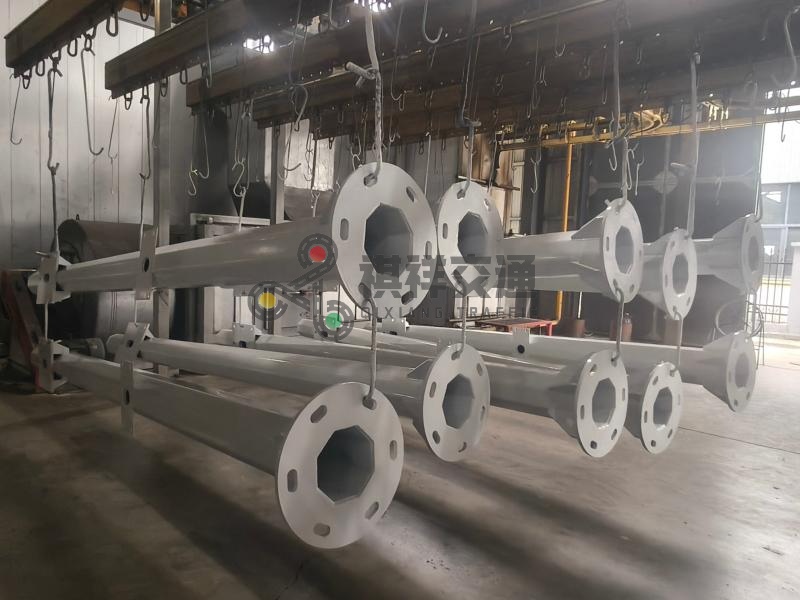
4. The Protective Coating Is Only One Part of the System
Surface protection plays an important role in slowing corrosion, but the coating should not be viewed as an independent solution.
Its effectiveness also depends on surface preparation, coating quality, coverage, handling, transportation, installation, and subsequent damage.
Scratches caused during transportation or construction can expose the underlying metal. Areas around welds, joints, flange connections, drainage points, and other details may also deserve closer inspection.
A well-protected pole can therefore last much longer when the protective layer remains intact throughout its service period.
For this reason, buyers should look beyond the phrase “galvanized traffic signal pole” and ask how the complete surface-treatment process is controlled.
5. Welding and Connections Can Influence Durability
The pole body may remain in good condition while a connection becomes the weak point of the structure.
Welded joints, flange connections, mounting brackets, bolts, and reinforcement components all transfer forces between different parts of the system.
Poorly executed welding can introduce defects that reduce structural reliability. Loose or deteriorated connection hardware can also create movement, vibration, or additional stress during operation.
A durable traffic signal pole therefore requires attention to both the main steel members and the details that connect them.
This is particularly important for structures with long arms or multiple mounted devices.
6. Foundation Quality Matters More Than It May Appear
A traffic signal pole is only as stable as the structure supporting it.
Even a well-manufactured pole can experience problems if the foundation is incorrectly designed, poorly constructed, or unsuitable for local soil conditions.
The foundation must work with the pole to resist overturning and other forces generated by wind and equipment loads.
Potential problems can arise from:
Incorrect foundation dimensions
Poor concrete quality
Incorrect anchor-bolt positioning
Insufficient embedment
Weak or unstable soil
Water-related deterioration
A foundation problem may initially appear as minor movement or misalignment, but continued movement can place additional stress on the pole and its connections.
Therefore, installation quality is an important part of the pole’s overall service life.
7. Service Life Is a Combination of Several Factors
It is tempting to ask whether a traffic signal pole can last 10, 15, 20 years, or longer.
In reality, there is no single number that applies to every installation.
A more useful way to evaluate service life is to consider the interaction between several factors:
Material + Structural Design + Surface Protection + Installation + Environment + Loading + Maintenance
If one part of the system is significantly weaker than the others, it can become the limiting factor.
For example, a well-protected steel pole may still experience premature problems if its foundation is inadequate. Likewise, a properly designed structure may suffer accelerated deterioration if the protective coating is repeatedly damaged and corrosion is not addressed.
Traffic signal pole service life is therefore a system-level issue rather than a single product specification.
Post time: Sep-18-2026


