
When purchasing signal lighting poles for road construction or intersection projects, buyers often focus on pole height, arm length, steel thickness, and surface treatment. However, receiving the correct pole structure does not necessarily mean the delivery is complete. Missing connection components, mounting accessories, or installation documents can cause unexpected delays at the construction site.
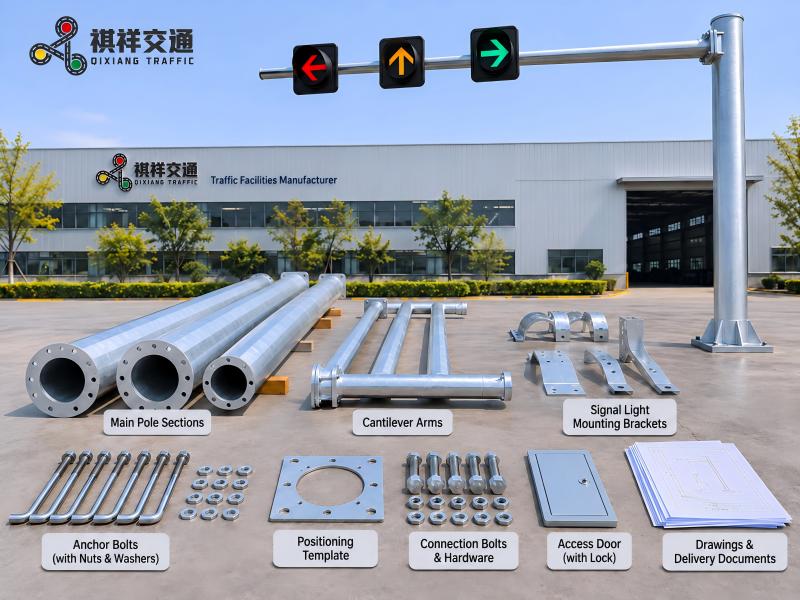
As a professional signal lighting pole manufacturer, Qixiang understands that a complete delivery set should include not only the main steel structure but also the necessary components required for assembly and installation. Before shipment, both suppliers and buyers should confirm the following items.
1. Main Pole Structure and Cantilever Arms
The main pole is the central component of the delivery set. Depending on the project design, it may be a straight pole, an octagonal pole, or a cantilever-type structure.
For cantilever signal lighting poles, the horizontal arm may be manufactured separately for easier transportation. Buyers should confirm that the correct number of arms is included and that each arm matches its corresponding pole.
The delivered structural components should be consistent with the approved drawings, including pole height, arm length, connection positions, and mounting arrangements.
2. Anchor Bolts and Foundation Components
Foundation accessories are particularly important for flange-mounted signal lighting poles.
A typical foundation connection may require anchor bolts, nuts, washers, and positioning templates. These components must match the dimensions and hole arrangement of the pole’s base flange.
However, foundation accessories are not automatically included in every quotation. Some projects purchase them separately or arrange local production.
Therefore, buyers should confirm whether the anchor bolt assemblies and templates are included in the manufacturer’s supply scope before placing an order.
3. Connection Bolts and Assembly Hardware
For signal poles with detachable arms or sectional structures, connection hardware is essential.
A delivery set may include structural bolts, nuts, washers, and other fastening components specified in the approved design.
These accessories should be packed and identified according to their corresponding connection locations. Mixing different bolt sizes or leaving components without identification can increase assembly time.
For projects involving multiple pole models, separate accessory packages can help installation teams avoid confusion.
4. Signal Light Mounting Brackets
Signal lighting poles are designed to support traffic signal heads, but the required mounting brackets can vary according to the signal equipment.
Different projects may require side-mounted brackets, arm-mounted fixing devices, or customized mounting plates.
Before shipment, buyers should confirm the mounting positions, bracket quantities, and compatibility with the selected traffic signal heads.
It is also important to distinguish between mounting brackets and the traffic signal lights themselves. Unless the purchase contract specifies a complete traffic signal system, signal heads may not be included in the pole delivery.
5. Access Doors and Cable-Related Accessories
Signal lighting poles commonly require internal space for cable routing and maintenance access.
Depending on the pole design, the delivery may include access door covers, door fasteners, cable entry protection components, and grounding connection provisions.
The access door should match the pole opening, while the cable routing arrangement should correspond to the approved installation drawings.
Electrical cables, terminal blocks, and other electrical accessories should be listed separately when they are required, rather than assumed to be part of the standard pole supply.
6. Drawings and Delivery Documentation
A complete delivery should also provide the documents agreed upon during order confirmation.
These may include approved fabrication drawings, component lists, installation guidance, packing lists, and applicable inspection records.
For customized signal lighting poles, drawings are especially useful because they help contractors identify the correct assembly arrangement and foundation connection details.
Providing clear documentation can reduce unnecessary communication between the manufacturer, importer, and installation contractor.
7. Packaging Identification and Quantity Verification
For large municipal projects, signal lighting poles may be delivered in different sizes and configurations within the same shipment.
Each pole and its corresponding accessories should be clearly identified to simplify sorting after unloading.
Before shipment, the manufacturer should verify the quantities of main poles, cantilever arms, connection hardware, and other contracted accessories against the packing list.
Protective packaging should also be arranged to reduce damage to galvanized or painted surfaces during transportation.
Conclusion
A complete signal lighting pole delivery is more than a collection of steel poles. It involves matching structural components, installation accessories, mounting hardware, and documentation to the actual project requirements.
For international buyers, confirming these details before production and shipment can help prevent missing parts, reduce installation delays, and simplify project coordination.
Qixiang provides signal lighting pole manufacturing solutions for different road and intersection applications. Customers are welcome to share their project drawings and technical requirements so that the appropriate pole configuration and delivery scope can be confirmed before ordering.
Post time: Nov-06-2026


