
What key factors need to be considered when setting and controlling traffic control lights? This article analyzes and discusses relevant standards, traffic flow characteristics, and road conditions.
In reality, not all at-grade intersections require the installation of intersection signals or traffic signal control. Practice has shown that implementing traffic signal control at intersections where it is unsuitable can actually lead to adverse control effects. Therefore, the choice of control method for at-grade intersections is a crucial issue that requires careful study and deserves sufficient attention from designers.
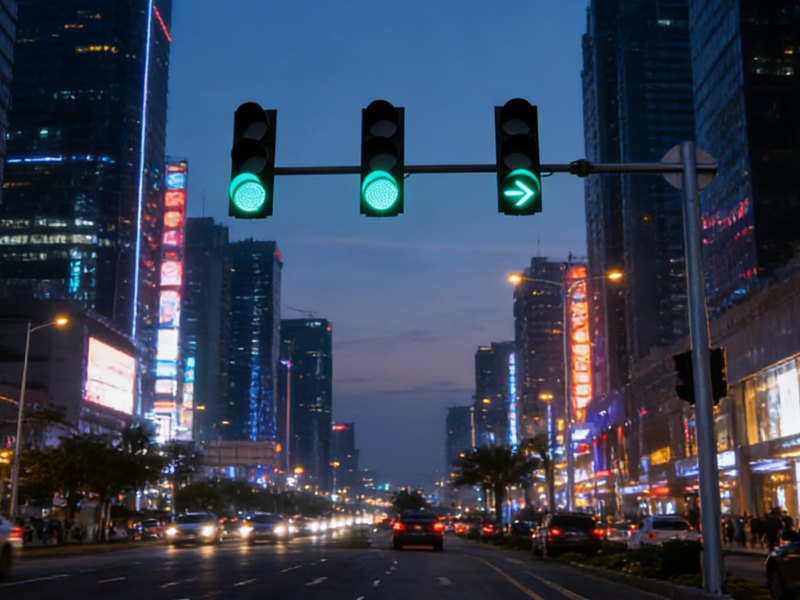
The main intersection signal control methods used at-grade intersections are: stop and yield control, yield control, signal control, and traffic police direction control.
Stop and yield control and yield control use specific traffic signs to control the passage of vehicles from side roads through the intersection;
Signal control uses traffic control lights to control the passage of vehicles and pedestrians from all directions through the intersection;
Traffic police direction control uses on-site directions from traffic police officers to control the passage of vehicles and pedestrians through the intersection.
Stop-and-yield control requires drivers of vehicles on side roads to stop and observe beyond the stop line before proceeding. Stop-and-yield control is primarily applied in the following situations:
(1) Traffic flow on the side road is significantly lower than that on the main road;
(2) From the perspective of vehicles on the side road, visibility and field of vision are not ideal;
(3) Traffic flow on the main road is complex, with many lanes or turning vehicles. At intersections using this control method, there should be a clear “Stop” sign at the side road entrance.
Slow-down-and-yield control requires drivers of vehicles on side roads to slow down and yield, observe the traffic situation on the main road, and proceed only when it is deemed safe, ensuring priority for vehicles on the main road. Slow-down-and-yield control is mainly applied at intersections where visibility at the side road entrance is good and traffic flow on the main road is low. At intersections using this control method, there should be a clear “Yield” sign at the side road entrance.
Traffic police command control requires vehicles entering the intersection to proceed in sequence according to the traffic police’s hand signals. Compared to traffic signal control, traffic police command and control is a relatively primitive traffic control method. However, due to the prominent phenomenon of mixed pedestrian and vehicle traffic at intersections in my country and the weak traffic awareness of urban residents, many drivers and pedestrians at intersections (especially in the following special circumstances) completely ignore traffic lights and signs, driving and crossing the road at will. Therefore, traffic police command and control remains a very effective control method. Traffic police command and control is beneficial for handling emergencies and has a good guiding effect on temporary traffic flow fluctuations. It is mainly applied to the following special situations:
(1) Traffic signal system malfunction;
(2) Traffic accidents occur at intersections, resulting in severe traffic congestion;
(3) During large-scale events or road construction.
Qixiang Traffic specializes in producing various types of intersection signals. Reliable quality and affordable prices. Welcome customers to inquire and purchase!
Post time: Mar-25-2026


