
Qixiang Traffic agrees that timing traffic signals is both scientific and human-centered.
“There used to be so many accidents here, it was terrifying to cross the road. Now it’s all better, finally there are traffic lights, crossing the road is no longer a problem.”
“Traffic light timing at intersections is a complex subject,” said Fu Binhua, deputy head of the Computer and Communication Management Section of the Research Institute of the Hangzhou Municipal Public Security Bureau Traffic Police Detachment. In order to establish a “one intersection, one file” system, every brigade, squadron, and police team carries out this responsibility at every level by closely examining and recording elements such as job attributes, traffic light phases, pedestrian crossing lengths, duty arrangements, traffic facilities, and timing schemes for each intersection. In order to create a “one road, one plan” for signal timing, they also coordinate the correlation between areas and roads. A special working group was also formed by the detachment to oversee traffic signals across the city. Every aspect was considered to ensure a thorough and accurate investigation.
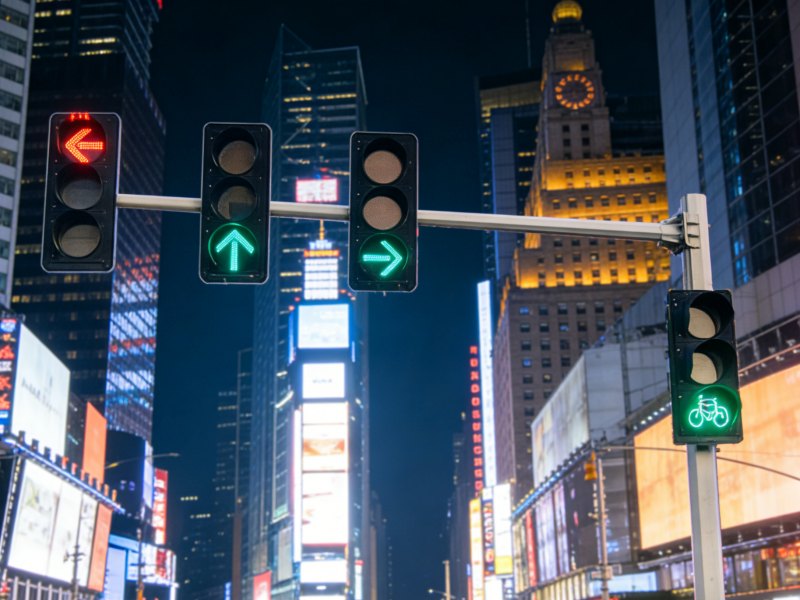
How to ensure scientific and reasonable traffic signal timing at intersections?
The basic principle of traffic signal timing at intersections is “one policy per hour, one policy per location,” which is highly targeted and timely. However, the overall optimization approach and principle is “every second counts in terms of time, and every inch counts in terms of space.”
From the perspective of maximizing the overall efficiency of the intersection system, signal optimization focuses on the following aspects: First, balancing traffic flow at all entrances. An intersection’s four entrances frequently reach saturation during periods of high traffic, creating lines in all four directions. In order to prevent unduly lengthy lines in one direction, the timing principle is to take into account all four directions. Making sure that upstream and downstream intersections are connected comes in second. Queuing at intersections during rush hour necessitates queue space. There are short lines at some entrances, and if you’re not careful, lines may reach upstream intersections and interfere with each other. We therefore make an effort to prevent intersections from interfering with one another. For example, at radial intersections entering the old city center, considering the longer radial queue space, the green light time will be shortened accordingly. As the saying goes, “If there’s congestion outside the city, it will spread to other areas.” “The city is congested, and there’s a huge traffic jam.” Thirdly, we consider priority weights. First, we prioritize public transport. The proportion of buses flowing in different directions at intersections varies, so we prioritize vehicles flowing in the main public transport direction. Second, we prioritize pedestrian traffic. The number of lanes for different directions at intersections varies, and traffic efficiency will differ at the same time. During peak hours, we often prioritize vehicles flowing in the main direction to serve more citizens. Fourthly, we improve intersection speed. Intersection efficiency is reflected in the traffic flow passing through the intersection per unit time. Traffic flow equals speed multiplied by density. Improving speed is key, and safety is the prerequisite.
Signal timing optimization is a fundamental aspect of traffic engineering. There are many working methods and techniques, such as the “conflict point timing method.” This is especially important at irregular intersections, where the time it takes for each direction to pass through the intersection is different, and the stop line cannot be used as the standard for starting and stopping green lights. Above concludes Qixiang Traffic’s introduction to the scientific, human-centered approach to traffic light timing.
Post time: Mar-10-2026


