
In the procurement and acceptance process of traffic signal light poles, wall thickness is often one of the most controversial parameters. As an octagonal signal light pole supplier, we frequently encounter situations where customers use calipers to measure the pole body and then raise questions: Why does the nominal 6mm octagonal pole have discrepancies in the measured data? This is not simply a matter of “cutting corners”, but involves multiple factors such as standard definitions, process characteristics, and measurement methods.
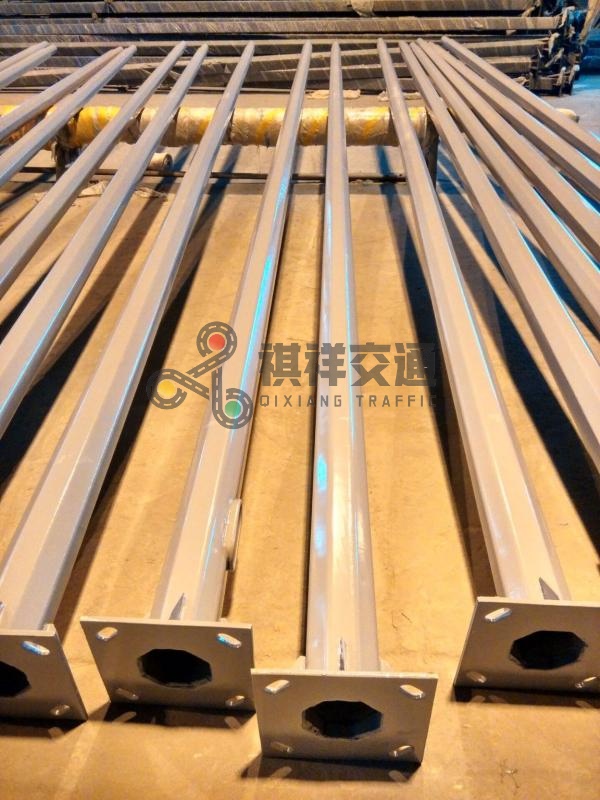
The essential difference between nominal wall thickness and measured wall thickness
Nominal wall thickness is the theoretical value specified in design documents or purchase contracts, usually presented as an integer or specific specification, such as 6mm, 8mm. It reflects the design intention and the basis assumptions of structural calculation. However, octagonal conical steel poles are made by bending steel plates or hot-rolling seamless steel pipes, and during the processing, negative deviations of the steel plates, reduction in thickness due to bending, and changes in thickness in the weld area can all cause the finished pole’s wall thickness to deviate from the nominal value. Industry procurement documents have recognized this, and some tenders require the pole wall thickness to be labeled as an “interval of 6mm-7mm” or “thickness ≥ 6mm” in a range form, precisely to leave room for manufacturing tolerances.
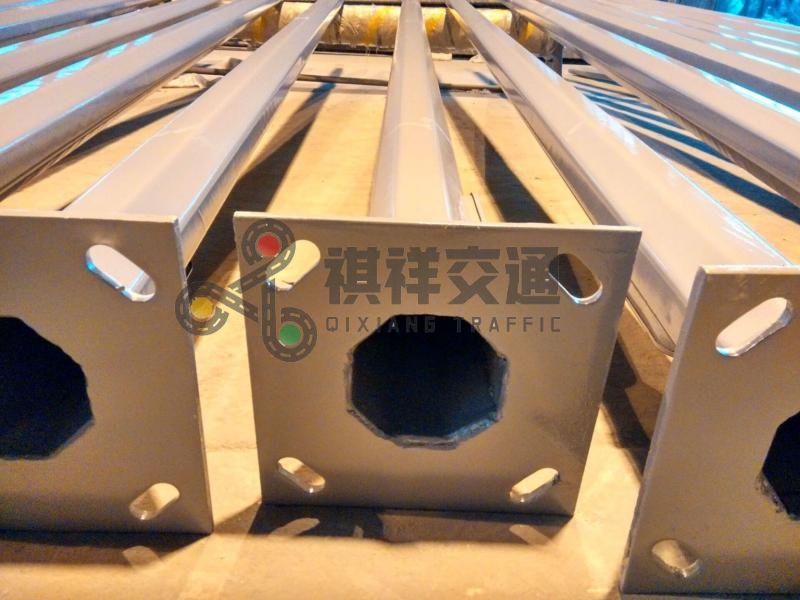
Measurement uncertainty of the measured value
Even if the finished octagonal traffic signal pole’s wall thickness conforms to the standard, the measured result may still deviate due to improper methods. Ultrasonic thickness gauges are commonly used for on-site detection, and their accuracy can reach 0.01mm when the wall thickness is less than 10mm. However, the selection of the measurement point is crucial: there are natural differences in thickness between the flat area and the edge transition area of the octagonal traffic signal pole. If the measurement point is placed in the area of reduced thickness due to bending, the reading will naturally be lower. In addition, although the zinc coating on the pole body is thin, if the sound velocity is not calibrated or the coating influence is not deducted, it will also introduce a small error. Standard measurement should avoid welds and edges, and take the minimum value from multiple planar areas of the pole body as a reference.
Reasonable expectations in industry practice
From the publicly available procurement technical specifications, the main pole wall thickness of octagonal signal light poles is commonly in the range of 5mm to 12mm, and the cantilever part is mostly in the range of 4mm to 8mm. The requirements for wall thickness vary significantly in different projects: the cantilever poles for ordinary intersections and those in areas with high wind loads are completely different. For the purchaser, instead of focusing on the absolute value of a single measurement point, it is better to clearly define the “minimum measured wall thickness” as the acceptance bottom line in the contract and agree on the measurement method and measurement point location. For the Octagonal traffic signal pole supplier, actively stating the allowable deviation range between the nominal value and the measured value, providing a third-party test report, is far more conducive to building trust than avoiding the issue.
Post time: Oct-30-2026


