
Solar road traffic signal lights are common devices in our daily lives. The entire system is powered by solar energy and backup batteries, protecting the environment and saving energy. Therefore, they are very popular with manufacturers and society. However, many people still have prejudices against these products, such as believing that their actual performance is not ideal. In fact, many problems such as not lighting up or short battery life are mostly caused by improper installation. Below, Qixiang Traffic will introduce eight common installation mistakes of solar traffic signal lights in detail.
1. Arbitrarily extending the solar panel connection wire
In some locations, excessive interference from the installation causes the solar panel and light to be separated by a considerable distance; two-core wires purchased from the market are then used to connect them arbitrarily. Due to the generally low quality of commercially available wires and the significant wire loss caused by the long distance between the wires, the charging efficiency will be greatly reduced, which will affect the illumination time of the solar traffic light.
2. Low solar panel charging efficiency
The accurate angle adjustment of the solar panel should follow simple principles, such as allowing direct sunlight to hit the solar panel, which maximizes its charging efficiency. The tilt angle of the solar panel in different locations can be referenced to the local latitude, and the tilt angle of the solar traffic light’s solar panel should be adjusted according to the latitude.
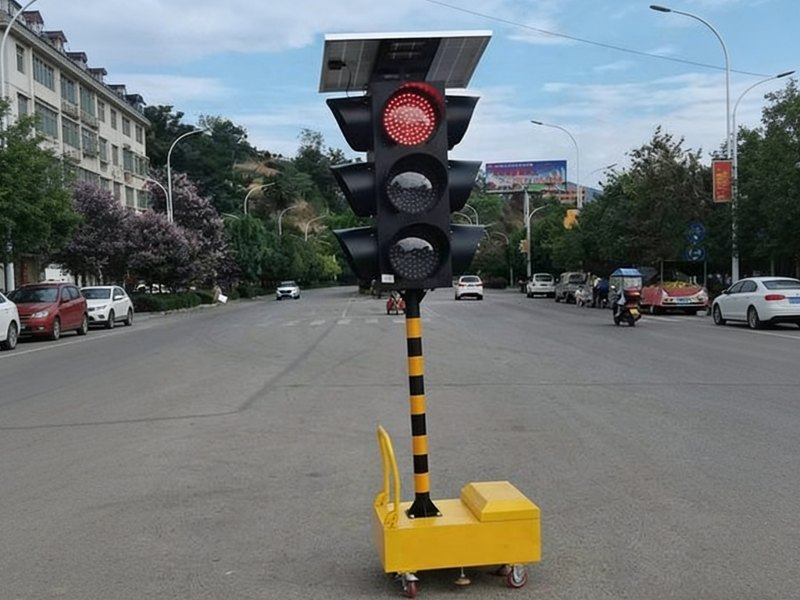
3. Double-sided installation causes solar panels to tilt face-to-face
Installers may install solar road traffic signal lights with the panels tilted symmetrically for aesthetic purposes. On the other hand, the opposite side will be incorrect if one side is facing the right direction. Its charging efficiency will be lowered if the wrong side is not exposed to direct sunlight.
4. Failure to light up
The charging voltage may be higher than the light control voltage point if a reference light source is close to the solar panel, which would stop the light from turning on. For instance, the solar panel will mistakenly recognize it as daytime if there is another light source close to the solar road traffic signal light.
5. Indoor charging of solar panels
For convenient parking at night, some customers install solar lights inside parking sheds; however, this drastically lowers charging efficiency. In this instance, we have two options: either install the solar panel independently of the light or charge outside and discharge indoors.
6. The solar panels’ charging efficiency is decreased when there are too many obstacles at the installation site.
For example, leaves, buildings, and other obstructions block sunlight, which has an impact on the absorption and utilization of solar energy.
7. Inaccurate parameter settings and non-illumination of the solar road traffic signal lights result from on-site staff using the remote control incorrectly.
When installing solar road traffic signal lights, there are eight common misconceptions. We hope that everyone can become proficient in the proper installation and operation techniques. In addition to improving product promotion, this will save energy.
Qixiang Traffic is a long-term wholesaler of solar traffic signals, directly supplied from the factory. Features include high-brightness LEDs, IP54 waterproof rating, long battery life even in rainy weather, and support for mobile/integrated customization. Bulk discounts are available, and global shipping is offered. Inquiries from engineering companies are welcome.
Post time: Mar-17-2026


