
As a manufacturer of traffic signal poles and street lighting solutions, we are frequently asked by municipal engineers and project planners: why do some traffic signal poles fail in high winds while others endure decades of storms? The answer lies in how traffic signal pole wind load is calculated, distributed, and mitigated during the design phase. This article examines the key factors that determine a traffic signal pole’s wind resistance.
Traffic Signal Pole Foundation
In the United States, the design of traffic signal support structures is governed by the AASHTO Standard Specifications for Structural Supports for Highway Signs, Luminaires, and Traffic Signals. The 2001 edition introduced major revisions, adopting a 3-second gust wind speed methodology instead of the previously used fastest-mile wind speed, and incorporating ASCE 7-95 as the standard reference.
The design wind pressure is calculated using a formula that multiplies base wind velocity squared by several coefficients: height and exposure factor (Kz), wind directionality factor (Kd), gust effect factor (G), and drag coefficient (Cd). For traffic signals, the recommended drag coefficient is 1.2, reflecting the aerodynamic resistance of signal heads and attachments.
The base wind velocity itself is determined by a mean recurrence interval that depends on traffic volume and risk category. According to AASHTO LRFD LTS-1, signal support structures serving roads with an average daily traffic (ADT) exceeding 10,000 vehicles should be designed for a 1,700-year recurrence interval, which in Ohio corresponds to a wind velocity of 120 mph. This is significantly more stringent than the 700-year interval (115 mph) often used for standard designs.
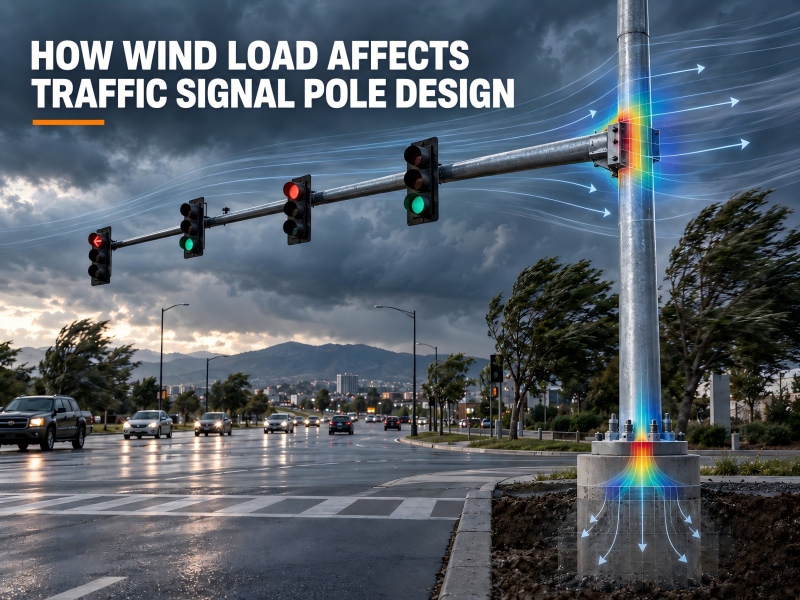
Where Traffic Signal Pole Wind Load Causes the Most Damage
Wind does not simply push against a traffic signal pole—it creates dynamic forces that can lead to fatigue failure. The most vulnerable location is the pole-to-mast arm connection, where the large mass of the cantilever arm creates high stress concentrations.
Field studies have revealed a troubling pattern. In Missouri, a dozen traffic signal mast arms failed, most after only one to two years in service. In Wyoming, visual inspection found that more than a third of traffic signal structures had fatigue cracks at the arm-to-pole connection. These failures are typically caused by wind-induced vibrations that accumulate stress cycles over time, compounded by the low mechanical damping (below 1%) of cantilevered structures.
Two distinct vibration phenomena are at work. Galloping, or Den Hartog instability, produces large-amplitude resonant oscillations in a plane normal to the wind direction. Vortex-induced vibration (VIV) occurs at lower wind speeds, typically below 20 m/s (45 mph), and can cause significant cyclic loading even in moderate conditions.
Structural Design Considerations
Several structural parameters directly influence wind resistance. Cantilever length is critical: the longer the mast arm, the greater the bending moment at the pole base and the higher the stress at the connection. Deflection limits are equally important—industry standards require that the displacement at the mast arm tip not exceed 1/75 of the arm length, and lateral deformation at any point of the pole should not exceed 1/33 of the corresponding height.
Material specification also matters. For poles in high-wind regions, Q345B or higher-strength low-alloy structural steel is recommended, with wall thickness typically no less than 3.5 to 4.0 mm for 10–12 meter pole heights. Hot-dip galvanizing combined with powder coating provides corrosion protection, which is critical because corrosion-induced cross-sectional reduction significantly weakens the pole’s wind resistance and shifts the yielding location toward failure.
Traffic Signal Pole Foundation Design: The Hidden Determinant
Even a well-designed pole will fail if the traffic signal pole foundation cannot resist the overturning moment generated by wind load. A study by the North Carolina Department of Transportation found that the most commonly used traffic signal pole foundation system for coastal traffic signal mast arm structures was a single conventional drilled shaft. However, when torsional loading demand is high—as occurs with long cantilever arms in exposed locations—some agencies have used drilled shafts with wing walls, though construction difficulties have led to a trend away from this approach.
A critical finding from the literature is that when drilled shafts are simultaneously subjected to lateral and torsional loads, their lateral load capacity is significantly reduced. Yet all state DOTs surveyed in the NCDOT study used decoupled design approaches that do not account for these interaction effects. This represents a potential vulnerability in current practice.
Mitigation Strategies
Beyond conservative structural design, several mitigation strategies can improve wind performance. Aerodynamic modifications to signal heads or mast arms can reduce excitation forces. A recent full-scale field study demonstrated that flat-plate aerodynamic dampers integrated with signal heads reduced in-plane vibration amplitudes by up to 35% and out-of-plane amplitudes by up to 50%, resulting in a 2.5-fold increase in estimated fatigue service life compared with an unmodified system.
For cantilevers exceeding 59 feet (about 18 meters), wind damping systems should be installed to suppress vibration. For arms longer than 35 feet (about 10.7 meters), a two-section structure is typically adopted to control arm weight and improve dynamic performance.
Conclusion
Traffic signal pole wind load is not a static force to be resisted—it is a dynamic phenomenon that interacts with the structure’s mass, stiffness, and damping characteristics over its entire service life. Effective traffic signal pole design requires attention to wind velocity mapping, connection detailing, material durability, traffic signal pole foundation behavior, and, where necessary, aerodynamic mitigation. For project planners, the key takeaway is to specify structures that match the wind environment of the specific site, rather than relying on generic designs.
Post time: Sep-22-2026


