
Traffic signal head configuration plays an important role in how effectively an intersection manages vehicle and pedestrian movements. Although many intersections use standard red, yellow, and green traffic lights, their signal arrangements can vary significantly depending on lane distribution, turning movements, road geometry, and traffic control requirements.
Choosing the right configuration is not simply about deciding how many traffic lights to install. It involves determining which signal indications are needed, how they should be combined, and where each signal head should be positioned to provide clear instructions to road users.
For traffic engineering contractors, road authorities, and traffic equipment distributors, understanding these differences can help improve intersection planning and avoid unnecessary equipment costs.
1. Simple Four-Way Intersections: Standard Three-Section Signal Heads
A conventional four-way intersection with relatively simple traffic movements usually requires a straightforward signal configuration.
A standard three-section vehicle traffic signal head, consisting of red, yellow, and green indications, is commonly used to control through traffic. Depending on the local traffic control plan, separate signal heads may be installed for different approaches.
This configuration is suitable when:
Each approach has relatively simple traffic movements.
Vehicles can share the same signal phase.
Dedicated turning movements are not required.
Pedestrian movements can be managed through a separate crossing arrangement when necessary.
For these intersections, a conventional full-circle signal head can provide clear and familiar instructions without introducing unnecessary signal indications.
However, the final number and position of signal heads should still be determined by the intersection layout and applicable traffic regulations.
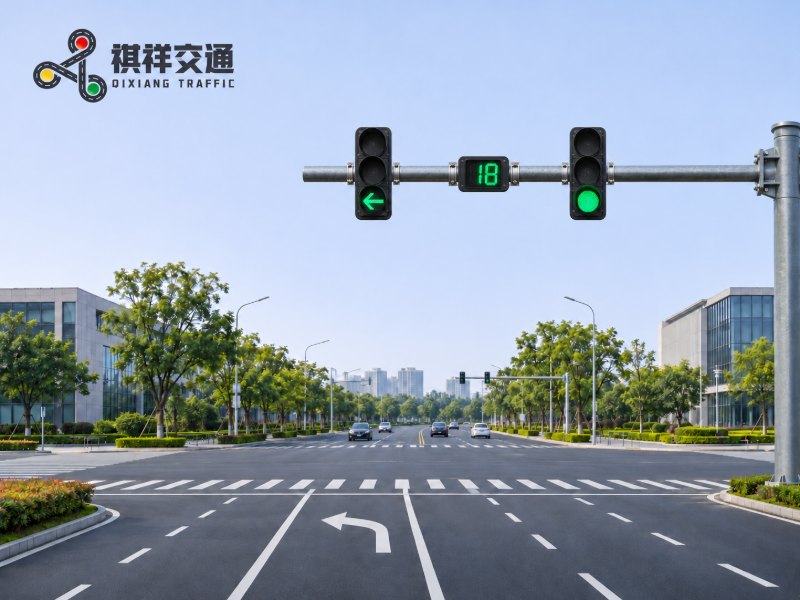
2. Intersections With Dedicated Left-Turn Lanes: Add Arrow Signal Heads
Intersections with dedicated left-turn lanes require more careful signal planning because turning vehicles may need to operate independently from through traffic.
In these situations, directional arrow signal heads can provide more specific instructions than conventional circular signals.
A typical configuration may include:
A red, yellow, and green circular signal for through movements.
A separate red, yellow, and green left-turn arrow signal for dedicated turning movements.
This arrangement allows the traffic signal controller to assign different phases to through traffic and turning vehicles when required by the approved traffic engineering design.
For example, a protected left-turn phase can give turning vehicles a dedicated movement period, reducing conflicts with opposing through traffic.
When selecting arrow signal heads, project planners should confirm the required arrow directions, the number of controlled turning lanes, and the intended signal sequence.
The objective is to ensure that drivers can easily distinguish the instructions applying to their particular lane.
3. Wide Multi-Lane Intersections: Consider Multiple Signal Heads
Wide intersections with several traffic lanes present a different visibility challenge.
A single signal head may not be sufficient to provide a clear view for every approaching driver, particularly when large vehicles, roadside structures, or other traffic obstruct the line of sight.
For these applications, multiple signal heads may be required at suitable positions.
Depending on the intersection design, the configuration may include:
Primary signal heads positioned near the roadside.
Supplementary signal heads installed overhead.
Additional directional arrow signals for dedicated turning lanes.
The purpose of using multiple signal heads is not simply to increase the number of lights. It is to improve the availability of clear and consistent signal indications for the relevant traffic movements.
Designers should also ensure that supplementary signal heads display consistent instructions and comply with local signal placement requirements.
Signal visibility, mounting height, viewing angle, and the distance between the signal heads and stop line should all be considered during the planning stage.
4. Intersections With Multiple Turning Movements: Use Directional Combinations
Some urban intersections include separate left-turn lanes, through lanes, and right-turn lanes. Others have unusual road geometry that creates several independent traffic movements.
A standard three-section circular signal may not communicate every movement clearly enough for these applications.
Directional arrow signals can help provide more specific instructions.
For example, a complex intersection may require:
Circular red, yellow, and green indications for general through movements.
Left-turn arrow signals for dedicated turning lanes.
Right-turn arrow signals where separate control is required.
Additional signal indications where approved traffic control plans specify them.
The exact combination depends on whether turning movements are protected, permitted, or controlled through separate signal phases.
It is important to avoid adding directional signals simply because more lanes are present. Each signal indication should correspond to an actual traffic movement and an approved control strategy.
A well-planned configuration makes it easier for drivers to understand which movements are permitted at each stage of the signal cycle.
How to Determine the Right Configuration Before Purchasing
Before selecting traffic signal heads for an intersection project, buyers and engineering teams should prepare several important details.
1. Intersection layout
Provide a road plan showing the number of approaches, traffic lanes, turning lanes, medians, and pedestrian crossings.
2. Traffic movement requirements
Identify which movements operate together and which require independent signal control.
3. Signal indication types
Determine whether the project requires full-circle signals, directional arrow signals, pedestrian signals, countdown displays, or other approved indications.
4. Signal head dimensions
Confirm the required signal dimensions and visibility specifications according to the project documents and applicable standards.
5. Mounting and installation positions
Determine whether the signal heads will be installed on roadside poles, mast arms, or other approved support structures.
6. Controller compatibility
Ensure that the selected signal heads and their electrical requirements are compatible with the traffic signal controller and the planned control system.
Providing these details before purchasing can help signal head manufacturers understand the project more accurately and recommend suitable equipment combinations.
Post time: Nov-19-2026


