
Single-column signs refer to road signs installed on a single pole, suitable for medium to small-sized warning, prohibitory, and instruction signs, as well as small directional signs. The inner edge of the installed column-type road sign must not encroach on the road construction clearance, and is generally no less than 25cm from the outer edge of the lane or pedestrian crossing or shoulder. The lower edge of the traffic sign is typically 150-250cm from the ground. When installed on municipal roads with a high proportion of passenger cars, the lower edge height from the road surface can be reduced depending on the specific situation, but should not be less than 120cm; when installed on the side of the road with non-motorized vehicle lanes, the height should exceed 180cm.
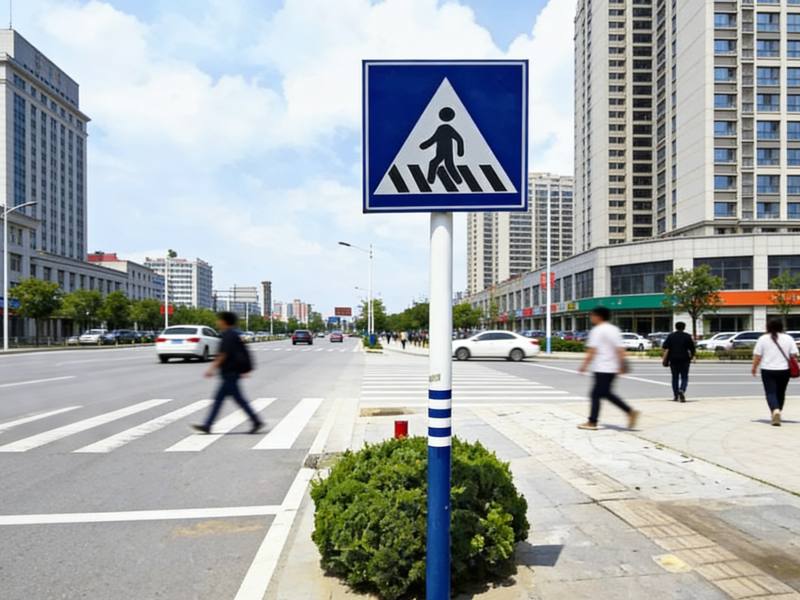
Single-column signs are commonly used on provincial highways, national highways, expressways, urban roads, residential areas, hospitals, and underground parking lots.
Traffic sign pole foundations are cast in place according to the layout requirements, and their quality management is mainly reflected in the concrete mix design. The concrete must be mixed according to the construction mortar mix ratio. The exposed portion of the road surface at the top of each foundation must be built in accordance with the engineering drawings and technical specifications. The basic building reinforcement arrangement, as well as the specifications for each component, should be consistent with the engineering drawings. Thin iron wire of the required diameter should be used to secure the intersections of horizontal and vertical reinforcement bars, ensuring no dragging or neglect. The engineering drawings should be followed when placing the foundation flanges. The tops of the foundation flanges should be flush with the tops of the concrete foundation walls, and they should line up with the foundation. The exposed length of embedded anchor bolts should be regulated between 10 and 20 cm, and they should be securely fastened vertically to the foundation flanges.
Tight concrete should be poured against the foundation pit’s intact excavation surface. The compressive strength of the poured concrete should meet the layout requirements. After the foundation pit is dug out, concrete should be poured within a day.
Vibratory compaction is crucial when pouring concrete. To ensure uniform density and avoid formwork displacement, compaction should be done layer by layer using either mechanical equipment or human labor. Make sure the anchor bolts and base flanges are positioned correctly during vibration.
All exposed edges should be neatly trimmed with a consistent concrete color, and the top of the base wall should be smoothed. The concrete surface needs to be smooth and level, free of uneven or honeycomb-like patches. After pouring, make sure the concrete satisfies curing requirements and stay out of direct sunlight.
To ensure the installation angle of double-column signs meets requirements, the axis between the two foundations should be carefully controlled during the construction of double-column sign foundations, especially when the two foundations have different heights.
To ensure the proper installation of the gantry sign load-bearing beams, the spacing between the foundations and the center line should be carefully controlled during the construction of gantry sign foundations. It must be based on the specific specifications and model of the gantry frame load-bearing beam.
Qixiang is a company that makes traffic sign poles. In addition to national standard reflective signs, our factory specializes in cantilever, double-column, and single-column sign poles. Customized thicknesses, patterns, and sizes are supported. We have quick delivery times, a large production line of our own, and plenty of inventory. We invite both new and current clients to get in touch with us for more information!
Post time: Dec-09-2025


