
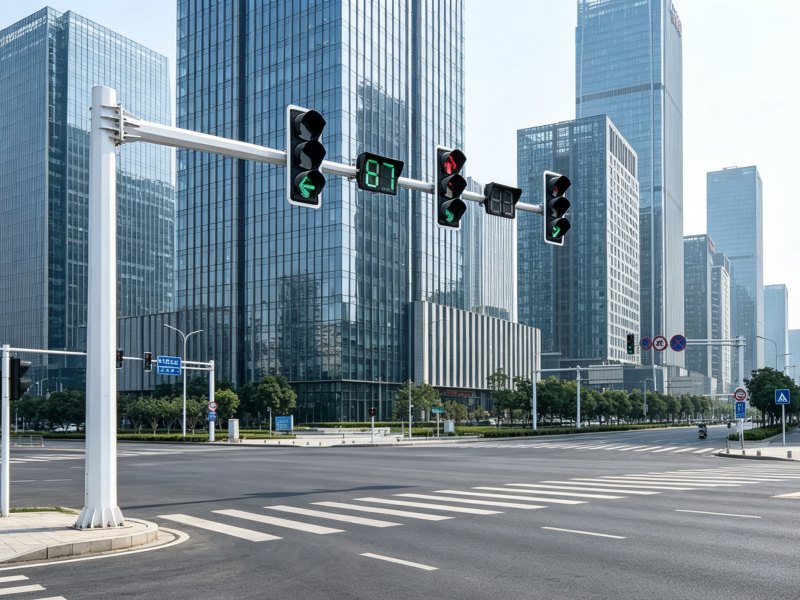
There are several important factors to consider when choosing high-quality signal pole welds. First, the general shape should be regular and uniform, with a smooth transition from the weld to the base material and a constant width. The weld should have no sharp edges or irregularities and blend in perfectly with the remainder of the traffic signal poles. The surface should be spotless and devoid of any noticeable flaws, such as spatter or weld slag. Additionally, a good weld should have a thick, flat texture and be full and even, with no weak spots or depressions. This increases the traffic signal poles’ durability and dependability by distributing its weight and stress evenly. You can be fairly certain that a weld is of high quality if it satisfies all of these requirements. The easiest way to assess a weld’s quality is to look at it; if traffic signal poles look good, they are likely to perform well as well.
Unsatisfactory welds are a major issue and are closely examined by inspectors. Common problems include porosity, slag getting trapped in the weld, cracks, and weak welds. Gases that became trapped during the welding process are typically the cause of numerous tiny holes or pits on the weld’s surface, which can significantly weaken the weld. Slag in the weld may result in an uneven surface that is more prone to crack under stress. The most significant issues, however, are weak welds and ones that don’t go all the way through; even if the surface appears fine, the weld may not be strong enough inside, making it unable to support a lot of weight and prone to breaking apart in the event of strong winds or vibrations. Additional issues with welds include burn-through in specific places, cracks of varying lengths, and improperly formed weld beads, all of which are regarded as subpar. In order to fix the welds before they cause any issues, inspectors must be vigilant in identifying these problems.
You can perform a few easy tests to ensure the quality of a weld. Tapping the weld gently is one method. It’s encouraging if it sounds firm and unambiguous. However, it is not good if it sounds hollow or dull. There shouldn’t be any weak spots in a good weld. It should also be the right thickness, according to the plans for the signal light poles. After the weld is done, it should be smoothed out and protected so it doesn’t rust or corrode too quickly. This is important to keep the weld strong and lasting. You can also check the weld by looking at it closely, to make sure it’s done properly and meets all the requirements.
Therefore, good welds are smooth, full, defect-free, and tightly fused, while bad welds have many holes, cracks, poor formation, and internal voids. In order to guarantee road traffic safety and the safety of traffic light poles, weld quality control is essential.
Our factory uses a unique welding technique that we have been using for a long time to create a variety of traffic signal poles. To ensure that the poles can withstand a great deal of stress, we make sure the welds are solid, uniform, and free of holes or weak areas. We spray the light poles with powder coating after submerging them in molten zinc to stop them from rusting. Because of this, they are long-lasting and resistant to strong winds. The signal light poles can also be customized to meet your unique requirements. To guarantee the superior quality of our poles, we closely monitor each stage of the manufacturing process. If you’re interested signal light poles, please don’t hesitate to ask us questions or place an order.
Post time: Jul-28-2026


