
1. National Standards: The Basic Constraints on Cantilever Length
The design of traffic signal poles in China must first comply with the Code for Layout and Installation of Road Traffic Signals (GB 14886-2016). This standard sets clear requirements for the mounting height and cantilever length of cantilever-mounted traffic signal poles. Taking into account the strength, durability, and stability of the pole structure, the height of a cantilever traffic signal pole generally does not exceed 7 m. The clear height of the signal lights should be within the range of 5.5 m to 7 m, ensuring that drivers of different vehicle types can clearly see the signals.
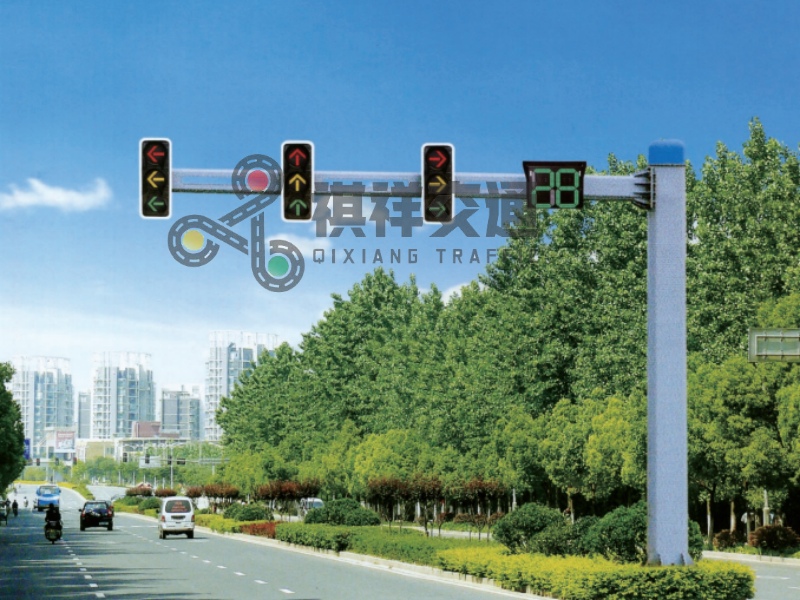
Regarding traffic pole cantilever length, the national standard provides a core principle: the cantilever length should not extend beyond the centerline of the innermost lane at its longest, and should not be shorter than the centerline of the outermost lane at its shortest. In simple terms, the signal light should be positioned above the target lane. It should neither extend into the opposing lane area nor be so short that it cannot cover the outermost lane. This principle is the starting point for all subsequent calculations.
2. Determining the Basic Cantilever Length by Number of Lanes
In actual engineering practice, the most direct method is to determine the basic traffic pole cantilever length according to the number of lanes on the exit side. Common industry practice has produced the following correspondence: when the exit side has 2 lanes, a 6 m cantilever is selected; for 3 lanes, 8 m; for 4 lanes, 10 m; and for more than 4 lanes, a 12 m cantilever can be used. These empirical figures are widely applied in real projects and can serve as a reference for preliminary selection.
For example, on a two-way four-lane road, the exit side usually has 2 lanes, so a 6 m cantilever is sufficient to place the signal above the lane. If one side of the road has three lanes (a two-way six-lane road), an 8 m cantilever is required. For roads with a central median, the width of the median also affects the arm span: the wider the median, the narrower the actual lane width on each side, and the traffic pole cantilever length can be shortened accordingly.
3. From Lane Center to Signal Position: Accurate Calculation
After the basic length is determined, an accurate calculation is still needed. The signal should be installed 2 m to 5 m from the stop line, with the reference axis perpendicular to the road centerline. The calculation of cantilever length can be simplified as:
Traffic light pole cantilever length = horizontal distance from the pole flange to the farthest signal mounting point (or sign edge) + allowance
Taking the standard of the Indiana Department of Transportation as an example, the precise arm length should be measured from the center of the pole to the end of the cantilever. When used to determine quantities, this length should be rounded up to increments of 5 ft (about 1.5 m). The Ohio standard further requires that the approximate arm length be the horizontal distance from the pole flange to a point 3 ft (about 0.9 m) beyond the center of the farthest signal attachment, or 1 ft (about 0.3 m) beyond the edge of the farthest sign attachment.
4. Adjusting Cantilever Length Under Special Road Conditions
The standard method is not universal. The following scenarios require targeted adjustments:
Curved road sections: The signal head position should be adjusted to within 3 ft of the tangent line of the corresponding lane at the stop line. When street trees or other obstructions affect signal visibility, the arm length should be extended to ensure visibility.
Intersections with heavy large-vehicle traffic: When frequent large vehicles block the signal, the pole height or arm length should be optimized and adjusted to ensure that the signal remains visible to smaller vehicles behind large vehicles.
Wide and complex intersections: Take the intersection of Zhonghua 5th Road and Xinguang Road in Kaohsiung as an example. The road width there reaches 40 m, with a total of 7 lanes in both directions. A conventional 7 m signal pole cannot provide sufficient recognition. The transportation bureau ultimately adopted a 10 m cantilever pole. Although the unit cost reached NT$200,000—more than twice that of a conventional 7 m pole—the actual installation greatly improved recognition and received positive feedback from commuters. This new pole can resist strong winds of Level 13 or above and uses hot-dip galvanizing and weather-resistant coatings to enhance durability.
Intersections on slopes: When the gradient is greater than 5%, the signal for the uphill direction should be lowered by 0.5 m, while the signal for the downhill direction should be raisedised by 0.5 m to match changes in driver sight lines.
5. Structural Loads: The Safety Bottom Line in Cantilever Length Design
Traffic pole cantilever length is not only a matter of visual effect; it directly affects the structural safety of the pole. The longer the cantilever, the greater the bending moment and torque the pole must withstand, and the higher the requirements for the foundation.
In terms of wind load, traffic light pole cantilever length is directly related to windward area. The displacement deflection at the end of the mast arm should not exceed 1/75 of the arm length. The allowable lateral deformation at any point of the pole should not exceed 1/33 of the corresponding height. For cantilevers longer than 59 ft (about 18 m), a wind damping system should be installed to suppress vibration. In addition, cantilevers longer than 35 ft (about 10.7 m) usually adopt a two-section structure to control arm weight.
Foundation design is also linked to cantilever length. Taking the Tennessee standard as an example, when the cantilever length is less than 60 ft (about 18.3 m), a foundation with a diameter of 3 ft (about 0.9 m) is required; for 60 ft and above, a foundation with a diameter of 4 ft (about 1.2 m) is required.
Conclusion
Determining the correct traffic light pole cantilever length is essentially a process of finding the optimal solution among covering the target lanes, meeting visibility requirements, and controlling structural loads. Project owners are advised to refer to the basic constraints of GB 14886-2016 during the preliminary design stage, determine the basic length based on the number of lanes and actual intersection conditions, and then verify load safety through structural calculations. For wide intersections, curves, or sections with dense large-vehicle traffic, special sight-line simulation and load analysis should be carried out, and customized solutions should be considered when necessary.
Post time: Sep-22-2026


