
Traffic signal poles support essential equipment at intersections, including traffic signal heads, electrical cables, controllers, and sometimes monitoring devices. Although the pole body is often the main focus during product selection, the access door also plays an important role in long-term maintenance. A poorly planned opening can make electrical inspection more difficult, restrict tool access, or create unnecessary challenges for technicians working in the field.
For traffic engineering contractors, municipal authorities, and traffic equipment buyers, access door design should be considered during the initial pole design stage rather than treated as a minor manufacturing detail. The right combination of opening position, dimensions, fastening method, and weather protection can make routine servicing more efficient while preserving the structural performance of the pole.
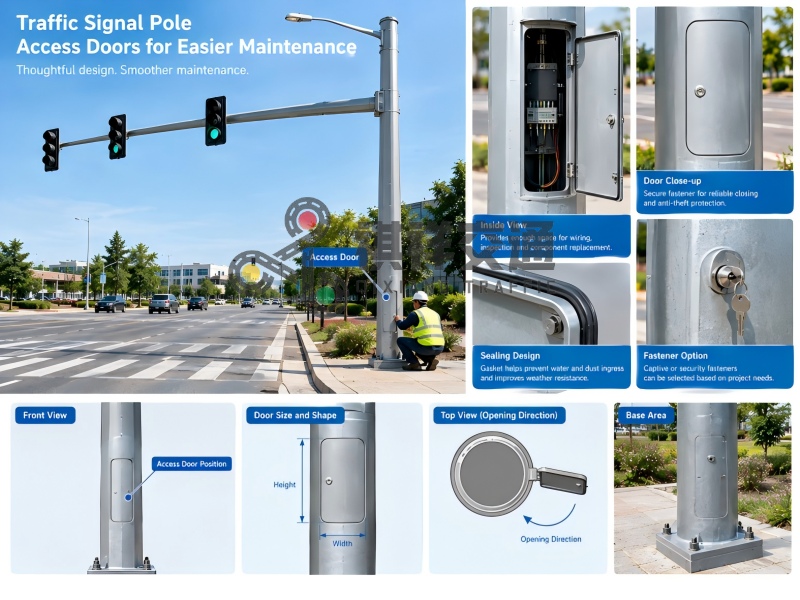
1. Select an Access Door Position That Supports Maintenance
The first consideration is where the access door should be located on the pole. Its position should correspond to the equipment that technicians need to inspect, connect, or replace.
For example, when cables enter through the pole base and continue upward, an access opening near the lower electrical connection area may provide convenient access to terminal blocks and cable routing. If additional equipment is installed inside the pole, the opening should allow technicians to reach the relevant components without unnecessary dismantling.
The surrounding environment must also be considered. An access door facing a narrow sidewalk, roadside barrier, or adjacent structure may be difficult to open safely. Designers should evaluate the available working space and consider how technicians will approach the pole during routine inspection.
The final location should be coordinated with the pole foundation, internal wiring arrangement, mounting accessories, and project-specific installation requirements.
2. Determine the Appropriate Door Size and Opening Shape
An access door must be large enough for its intended maintenance tasks. A small opening may be sufficient for visual inspection or access to a limited number of electrical connections, while more complex installations may require additional space for tools and component replacement.
However, making the opening unnecessarily large is not always beneficial. Removing too much material from a steel pole can affect its local strength and stress distribution, particularly in areas subjected to bending loads.
The design should therefore balance accessibility with structural requirements. Door dimensions, corner geometry, and the surrounding reinforcement should be evaluated according to the pole’s material, wall thickness, cross-section, and loading conditions.
Before production, the manufacturer and project engineer should confirm the required opening dimensions and ensure that the design remains compatible with the approved structural calculations. There is no single access door size that is suitable for every traffic signal pole.
3. Design the Cover for Convenient Opening and Secure Closing
The access door cover should be easy for authorized maintenance personnel to open, inspect, and close. At the same time, it must remain securely attached during normal operation.
Fastening options may include security bolts, captive fasteners, or other project-approved locking arrangements. The choice depends on the required security level, maintenance frequency, and local operating conditions.
Captive fasteners can be useful because they remain attached to the cover during servicing, reducing the possibility of losing small components on the roadside. Where unauthorized access is a concern, a suitable security fastening system can provide an additional layer of protection.
Designers should also check that the cover fits the opening accurately and does not interfere with nearby pole components. The closing method should allow technicians to secure the cover without forcing it into position or applying excessive tightening force.
4. Pay Attention to Sealing and Corrosion Protection
Traffic signal poles are exposed to rain, humidity, dust, temperature changes, and other outdoor conditions. An access door introduces a joint into the pole wall, so the cover and its surrounding interface require careful consideration.
Where the application requires additional weather protection, a compatible gasket or sealing arrangement can help limit water and dust ingress. The sealing material should suit the expected temperature range, environmental exposure, and maintenance requirements.
The door interface should also be coordinated with the pole’s surface treatment. For hot-dip galvanized or coated steel poles, fabrication and finishing procedures should protect exposed steel surfaces and maintain suitable corrosion resistance around the opening.
Drainage and moisture management deserve attention as well. The design should avoid creating unnecessary pockets where water can accumulate, while the internal electrical arrangement should follow the project’s applicable enclosure and wiring protection requirements.
The required ingress protection level must be determined for the complete assembly and its intended environment rather than assumed from the door cover alone.
5. Preserve Structural Strength Around the Opening
An access door is a functional opening in a load-bearing structure, not simply a removable panel. Its location and geometry can influence the local stress distribution of the pole.
For cantilever traffic signal poles, the structural design must account for the loads generated by the pole arm, signal heads, signs, wind, and other specified equipment. Designers should evaluate the access opening in relation to these loads and the pole’s critical structural regions.
Reinforcement, opening geometry, and local wall thickness should be determined by engineering calculations where required. The door should not be positioned or modified in a way that compromises important structural details or interferes with welds and connections.
During manufacturing, the opening dimensions, cover fit, and relevant welds should be checked against the approved drawings. Any change to the access opening should be reviewed before implementation instead of being made informally on the production floor or at the installation site.
6. Make Internal Wiring and Component Access Practical
An access door is useful only when technicians can reach the components behind it. Internal cable routing should leave sufficient working space for inspection, connection tightening, and replacement of specified electrical components.
Terminal blocks, cable entries, grounding connections, and other serviceable parts should be arranged so that technicians can identify them without excessive obstruction. Cable bends and routing paths should also remain compatible with the applicable electrical requirements.
Where multiple cables or auxiliary devices are installed, the internal layout should be reviewed before the pole is manufactured. This helps ensure that the planned opening provides genuine access to the equipment rather than merely satisfying an external appearance requirement.
For projects with customized electrical configurations, coordination between the traffic pole manufacturer, electrical equipment supplier, and installation contractor is particularly important.
7. Confirm Access Door Details Before Production
Before approving the final traffic signal pole drawings, buyers should review the access door as part of the complete pole assembly.
The review should cover the door position, opening dimensions, cover design, fastening method, sealing requirements, internal equipment arrangement, and surface treatment. Drawings should identify the relevant dimensions and reference points clearly enough for manufacturing inspection.
For customized projects, a sample cover or assembly review may also help confirm that the door can be opened and closed as intended and that the required tools and components can be accessed.
These checks are especially useful when a project includes multiple pole heights, cross-sections, or electrical configurations. Confirming the details early can reduce avoidable modifications after delivery and make installation planning more straightforward.
Conclusion
Traffic signal pole access doors may be relatively small components, but their design directly affects maintenance convenience, equipment accessibility, and the long-term usability of the pole. Door position, opening dimensions, fastening arrangements, weather sealing, structural reinforcement, and internal wiring space should all be considered together.
For traffic signal pole manufacturers and project buyers, the most effective approach is to define maintenance requirements before production and incorporate them into the approved engineering drawings. A properly designed access door helps technicians perform routine work more efficiently while supporting the structural integrity and environmental protection requirements of the complete traffic signal pole.
Post time: Oct-16-2026


