
Choosing a traffic signal pole is not simply a matter of selecting a height, shape, or finish. The pole must work with the geometry of the intersection, the number of traffic lanes, the position of signal heads, and the visibility requirements of approaching drivers.
A pole that works well at a compact urban junction may be unsuitable for a wide multi-lane intersection. Similarly, a solution designed for a major arterial road may be unnecessary for a small local intersection.
For road contractors, traffic authorities, and traffic equipment distributors, the better approach is to start with the intersection itself and then determine the most suitable pole configuration.
1. Start With the Intersection Layout
Before selecting a traffic light pole, examine the basic characteristics of the intersection.
Important factors include:
Number of approaches
Number of lanes on each approach
Roadway width
Left- and right-turn lanes
Median width
Pedestrian crossing locations
Stop-line positions
Distance between the traffic signal pole and the intended signal heads
Existing roadside equipment
Local wind and environmental conditions
The same traffic signal head may require a completely different supporting structure depending on where it must be positioned.
For example, a narrow four-leg urban intersection may only need signals positioned close to the roadside. A large junction with several through lanes and dedicated turning movements may require signal heads to extend farther over the roadway so that drivers in different lanes can see them clearly.
This is why signal pole selection should be treated as part of the overall intersection design rather than as an isolated purchasing decision.
2. Compact Urban Intersections: Keep the Structure Simple
Small urban intersections typically have relatively short crossing distances, limited lane numbers, and buildings or other roadside infrastructure close to the roadway.
In this situation, a compact traffic signal pole configuration can often be the most practical solution.
A straightforward vertical pole with an appropriately sized signal support may be suitable when the signal heads can remain close to the roadside while still providing adequate visibility.
The main considerations are:
Available sidewalk or roadside space
Signal visibility
Pedestrian movement
Clearance from buildings and street furniture
Ease of installation and maintenance
A large cantilever structure may add unnecessary structural complexity if the roadway does not require a long horizontal reach.
The goal is not to use the largest pole available. It is to provide the required signal position with an efficient structure.
3. Wide Multi-Lane Intersections: Prioritize Signal Reach
Large arterial intersections create a different challenge.
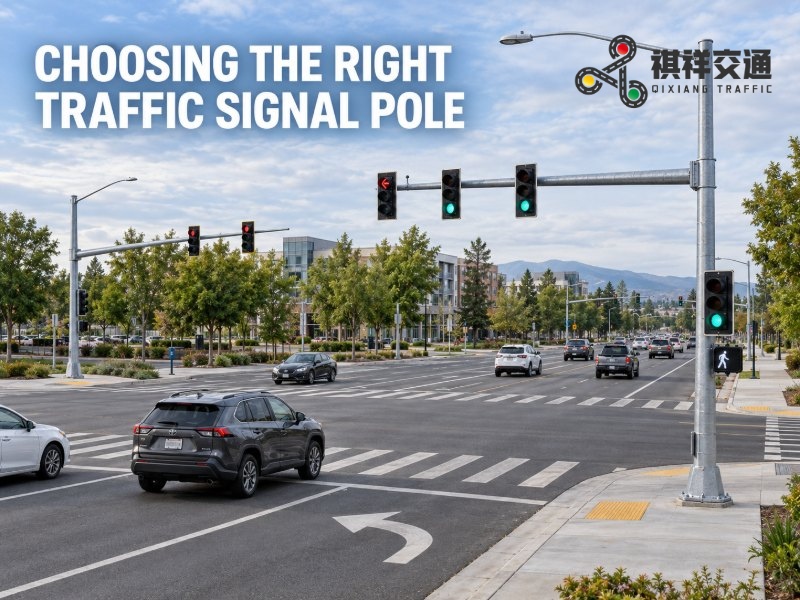
When several traffic lanes must be controlled, a roadside-mounted signal may not provide sufficient visibility for every approaching driver. In these situations, a mast-arm configuration can provide a more controlled position for the signal heads.
Mast arms allow the signal equipment to extend over the roadway and can provide a more predictable relationship between the signal head and the lanes it controls. FHWA guidance identifies mast arms as one of the major configurations used for vehicle signal displays and notes their precise signal-head placement and lower maintenance requirements compared with span-wire systems. Federal Highway Administration
For a wide intersection, the traffic light pole design should therefore be evaluated together with:
Mast-arm length
Number and weight of signal heads
Signage mounted on the arm
Wind loading
Foundation requirements
Roadway clearance
Future equipment requirements
The horizontal reach should be calculated from the actual signal layout rather than selected simply because a longer arm appears more versatile.
4. Large or Irregular Intersections: Consider Flexible Signal Placement
Some intersections are difficult to describe as a simple four-way junction.
Examples include:
Skewed intersections
Large five-leg intersections
Complex urban junctions
Intersections with irregular lane arrangements
Wide approaches with multiple turning movements
These layouts can make precise signal positioning more difficult.
A span-wire arrangement can offer flexibility because signal heads can be positioned at different points across the roadway. FHWA materials note that span-wire configurations can accommodate large intersections and provide flexibility in signal-head placement, although they can require more maintenance and may be affected by wind and ice.
For projects where flexibility is more important than a rigid overhead structure, span-wire support may therefore be worth evaluating.
However, the decision should also consider the local climate, maintenance resources, appearance requirements, and applicable road standards.
5. Existing Intersections: Replacement Does Not Always Mean Redesign
When upgrading an existing intersection, the best solution may not be to replace every component.
Existing foundations, conduit routes, roadside space, signal locations, and controller cabinets can all affect the new pole configuration.
Before ordering replacement poles, project teams should document:
Existing pole locations
Foundation dimensions
Arm lengths
Signal mounting positions
Existing cable routes
Roadway and sidewalk conditions
Additional equipment planned for the upgrade
This information can help the manufacturer determine whether a standard structure is suitable or whether a customized design would provide a better fit.
6. A Simple Decision Guide
A practical way to approach pole selection is to match the structure to the intersection challenge:
|
Intersection Condition |
Key Requirement |
Pole Configuration to Consider |
| Small urban junction | Compact installation | Simple roadside or short-arm configuration |
| Medium-width intersection | Improved signal positioning | Cantilever or mast-arm structure |
| Wide multi-lane junction | Long signal reach | Mast-arm configuration |
| Large or irregular intersection | Flexible signal placement | Span-wire or customized overhead structure |
| High-speed approach | Early and clear visibility | Overhead signal support |
| Heavy truck traffic | Reduce signal obstruction | Mast-arm or span-wire arrangement |
| Pedestrian-intensive area | Safe circulation and accessibility | Carefully positioned pole with suitable signal supports |
| Strong-wind environment | Structural stability | Engineered pole and foundation system |
| Existing intersection upgrade | Compatibility | Customized replacement or retrofit solution |
This table should be treated as a starting point rather than a universal specification. Local traffic standards and the final signal pole selection should determine the actual configuration.
Post time: Sep-18-2026


