
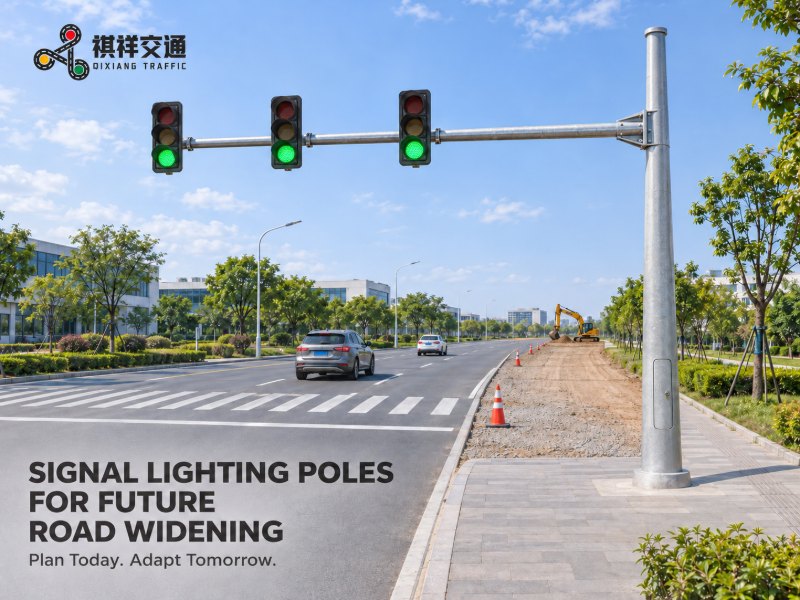
A road may open with two approach lanes and gain a turning lane several years later. When that happens, an otherwise serviceable signal lighting pole can become an obstacle: its foundation may occupy the new lane, or its arm may no longer reach the required signal positions.
Yes, a signal lighting pole can be designed to accommodate a defined widening plan. The opportunity depends on knowing how the road will change and checking the installation at each stage. A useful specification describes what can remain in service, what will need replacement, and which future changes require another engineering review.
1. Put the Present and Future Road Layouts on One Drawing
Begin with an overlay showing the existing intersection and the proposed widened arrangement. Include the future curb line, lane assignments, turning paths, crossings, drainage works, and finished road levels.
This comparison reveals whether the proposed traffic pole location remains usable. Widening toward the median creates different conflicts from widening outward toward the sidewalk. A future turning lane may also shift the stop line or require a separate signal indication. Planning signal positions for future lane changes and widening is also recognized in GDOT’s design guidance.
Where the widening scheme is still provisional, record the assumptions explicitly. Designing for one additional lane does not establish suitability for every later intersection redesign.
2. Choose a Foundation Position That Can Survive the Widening
Retaining the original foundation can avoid substantial excavation, but only if it remains clear of the future carriageway and other planned works. Check the entire foundation footprint against drainage trenches, utility diversions, curb ramps, and pedestrian routes.
Moving the traffic pole farther back may help preserve its location, although the greater setback can increase the arm reach needed for today’s installation. Both arrangements therefore need review before the location is fixed.
Also consider future access. A foundation that remains outside the pavement is of limited benefit if technicians cannot reach the inspection opening or position maintenance equipment safely.
3. Calculate Two Complete Operating Configurations
The structural brief should describe the equipment installed initially and the equipment expected after widening. For each configuration, identify arm geometry, attachment locations, equipment mass, and surfaces exposed to wind.
Moving a signal head farther from the shaft changes its leverage. Adding a backplate changes the wind exposure. These changes affect the load path through the arm connection, shaft, base plate, anchors, and foundation.
The responsible engineer should assess strength, movement, fatigue where applicable, and foundation performance under the governing project criteria. A statement such as “extra capacity included” is insufficient unless the drawings and calculations identify the future arrangement it covers.
4. Decide Whether the Arm Will Stay or Be Replaced
One option is to install an arm that can serve both lane layouts, with approved signal mounting positions for each stage. Another is to retain the shaft and foundation while replacing the arm when the road changes.
The second option requires the initial shaft, connection, anchors, and foundation to be verified for the future assembly. A detachable arm is not automatically interchangeable with a longer one. Matching bolt holes alone does not establish structural compatibility.
For example, a planned third approach lane might require repositioned heads rather than an extra-long arm. The traffic layout should determine the change, followed by structural verification of that specific configuration.
5. Keep Future Civil Works Away from Essential Connections
The widening plan should show which underground connections will remain accessible after construction. A pull box beside today’s curb could end up beneath the future carriageway or within a drainage excavation.
Where justified, reserve approved conduit capacity and locate connection points outside the affected work area. Coordinate any future pavement level changes with signal clearance and foundation elevation. These decisions can determine whether the retained pole is practical to reconnect when the new lanes open.
6. Record the Conversion Plan Before Ordering
Ask for a drawing schedule that distinguishes components retained, relocated, replaced, and added during widening. Preserve the design assumptions, connection details, and approved equipment positions with the project records.
Include the construction stage in this review. Arm replacement or pole relocation may require temporary traffic control while permanent signals are unavailable. When the widening project proceeds, reassess the retained structure’s condition and confirm that the actual road design still matches the original assumptions.
For buyers discussing traffic poles with Qixiang, sharing both road layouts at the quotation stage provides a clearer basis for comparing options. The aim is a documented route from the first installation to the widened road, with realistic limits on what the original structure can accommodate.
Post time: Nov-13-2026


