
We are all familiar with solar-powered appliances in our daily lives; solar energy is truly a great invention. Against this backdrop, solar-powered traffic lights have emerged. Compared to ordinary traffic lights, solar-powered traffic lights are more environmentally friendly and energy-saving. Because they have energy storage capabilities, they do not require cable laying during installation, effectively avoiding power outages caused by construction. Even under continuous rain, snow, or cloudy conditions, solar-powered traffic lights can operate normally for 72 hours. Therefore, they are popular with the public. So what are the basic functions of mobile solar-powered traffic lights? Today, traffic signal lamp supplier Qixiang will summarize and introduce them for you.
1. When the battery is low on power, it will automatically charge if there is sunlight.
2. If the battery is not fully charged and the sunlight disappears while charging, it will temporarily return to normal operation (lights off/flashing), and will re-enter charging mode when sunlight reappears.
3. It actively monitors the lithium battery voltage of the mobile solar-powered traffic light. When it falls below 3.5V, it enters a low-power state and the system goes into sleep mode, periodically waking up to monitor whether charging is possible.
4. Throughout the day, the system is in sleep mode and the lights are off. To check battery voltage and ambient brightness and decide whether to switch to a different mode, it automatically wakes up on a regular basis.
5. The traffic light powered by solar energy automatically cuts off charging when the battery is fully charged (battery voltage greater than 4.2V after disconnecting charging).
6. It will go into charging mode while in use if the lithium battery voltage falls below 3.6V and sunlight is available for charging. Don’t let the lights go into low-power mode so they don’t flash when the battery voltage falls below 3.5V.
7. Similar to the breathing light on an Apple laptop, the LED brightness of the solar-powered traffic signal light will gradually change after daybreak in accordance with a breathing pattern: 1.5 seconds of inhalation (gradual brightening), 1.5 seconds of exhalation (gradual dimming), pause, and then inhale and exhale again in a cycle.
The application of mobile solar-powered traffic signals is becoming increasingly widespread!
To adapt to new traffic needs, many cities are undertaking large-scale road construction. The deployment of mobile solar-powered traffic signals at intersections not only saves energy but also better maintains normal traffic order in emergencies.
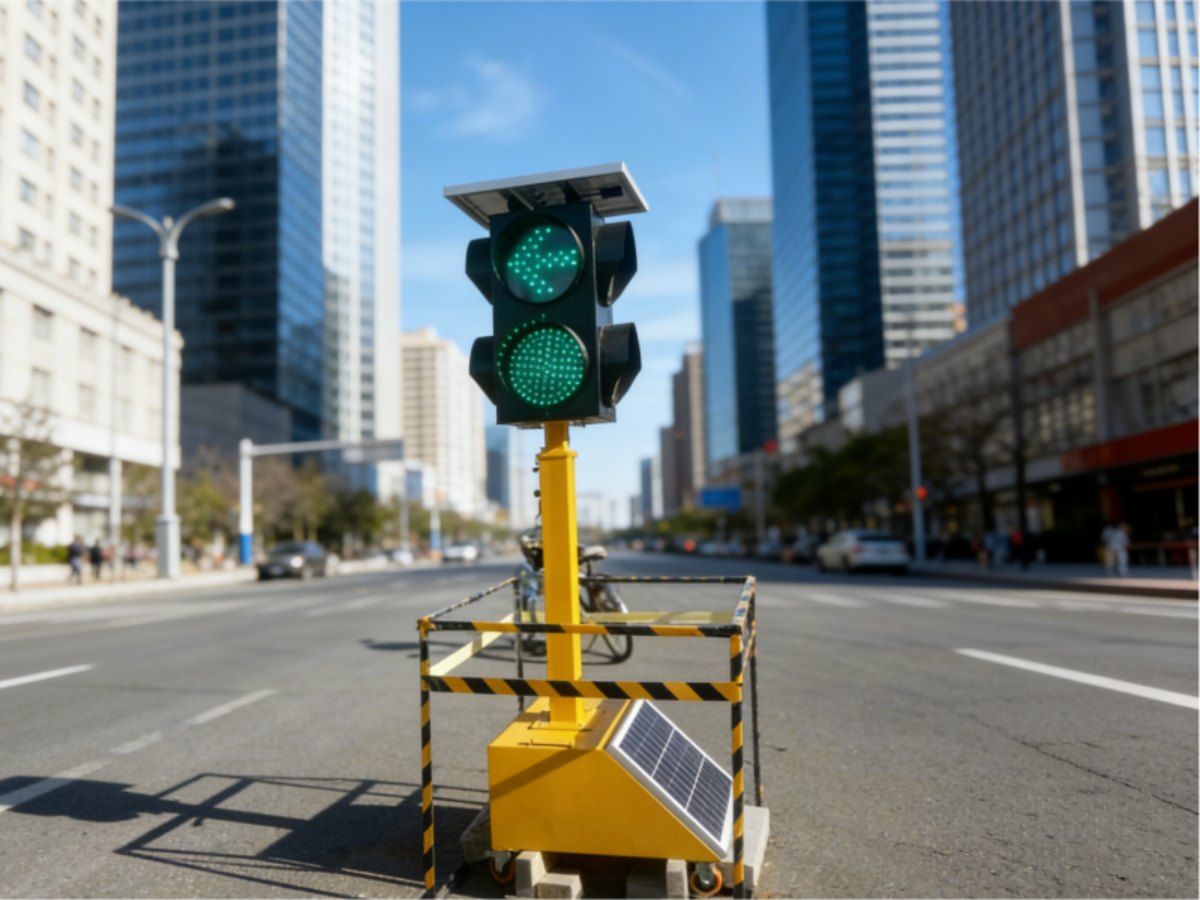
Mobile solar-powered traffic signals have been widely adopted at narrow intersections in urban areas. This application has solved the problem of congestion and traffic flow at narrow intersections. The mobile solar-powered traffic signal light is powered by solar panels, saving energy. Additionally, it is compact, takes up little room, and can be easily moved to different intersections when necessary thanks to the base’s four casters.
During dismissal, mobile solar-powered traffic lights are installed at some school gates to improve traffic control and student safety.
There has been a noticeable improvement in traffic flow at intersections since the mobile solar-powered traffic lights were implemented. This is because they have helped to regulate and control traffic order at intersections during morning and evening rush hours.
When a traffic light at an intersection suddenly malfunctions or some traffic lights cannot function properly due to a power outage, police officers can promptly move the mobile solar-powered traffic lights to direct and manage traffic, better maintaining normal traffic order in emergency situations.
Post time: Mar-03-2026


