
In the procurement and technical communication of traffic signal light poles, the dimension marking of the cross-sectional size of the octagonal conical pole often leads to misunderstandings. Many project drawings or lists only state “diameter Φ230mm”, but do not specify whether this is the side distance or the diagonal distance. For an octagonal cross-section, these two differ by approximately 8%, a seemingly insignificant figure, but it is sufficient to affect the matching of flanges, the selection of clamps, and even the structural calculation, becoming a “hidden trap” buried in the drawings.
The side dimension refers to the vertical distance between the two parallel flat sides of the octagon, which is the effective width that the pole actually bears bending moments and is also the direct basis for the layout of bolt holes on the flange. The diagonal dimension is the maximum external distance between the two opposite vertices, usually used for packaging and transportation limits or for rough comparison with circular poles. Geometrically, the diagonal dimension of a regular octagon is approximately 1.082 times the side dimension.
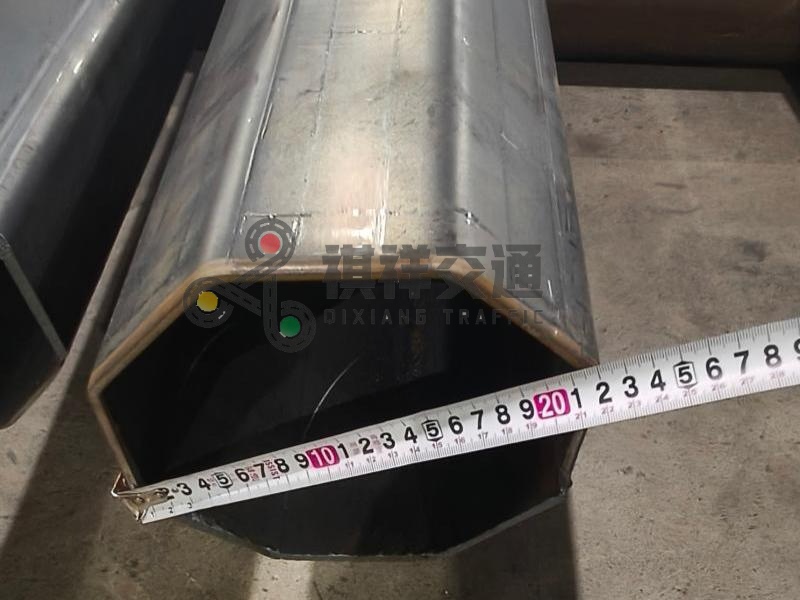
In other words, an octagonal conical pole marked “diagonal Ø280mm” has a real side of only about 259mm. If the purchaser matches the clamp or opens the flange based on a 280mm side, the on-site installation will inevitably have excessive gaps or bolt hole misalignment. Minorly, it will require rework and enlarging the holes, and severely, it will result in the complete scrapping of the flanges.
This difference is particularly crucial at the cantilever connection points of the octagonal conical poles. The vertical octagonal traffic signal pole and the horizontal arm are connected through flanges and stiffening ribs. The flange size is usually processed based on the side dimension. In our production, we strictly follow the principle of giving priority to the side dimension annotation and simultaneously attach the reference value of the diagonal dimension in the drawings to avoid secondary conversion errors in the processing and installation stages.
Taking a conventional 6.5-meter octagonal conical pole as an example, the lower diameter side dimension of 210mm corresponds to a diagonal of approximately 227mm. These two cannot be mixed. For example, for an 8-meter octagonal conical pole, the lower diameter side dimension is often taken as 240mm, and the diagonal is close to 260mm. If the lower flange is ordered based on the diagonal, the inner diameter of the clamp will have a surplus of nearly 20mm, and after pre-tightening the bolts, it is prone to slip. Under long-term exposure to wind loads and the vibration of the signal light itself, the connection reliability will be greatly reduced.
From the perspective of industry collaboration, inconsistent dimension benchmarks will also slow down the supply chain efficiency. Factories cut materials according to the drawings, and installation teams carry out construction based on the goods. Once the benchmarks are misaligned, the responsibility definition often gets into a tug-of-war. We suggest that industry professionals require the annotation of “side × diagonal” as a dual parameter when reviewing drawings and placing orders, or clearly define the benchmark definition in the technical agreement, and add the note “sectional benchmark: side” in the title bar of the drawings.
Details determine success, and annotations affect safety. We are specializes in the manufacturing of octagonal conical poles and supports custom dual annotations of “side × diagonal”. Welcome to provide drawings and inquiries about our octagonal traffic signal poles.
Post time: Oct-30-2026


